To Translate or not to Translate? MBM Provides General Guide for Businesses Operating in the Province of Québec after June 1, 2025

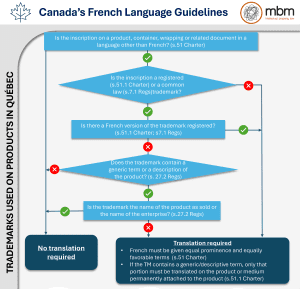
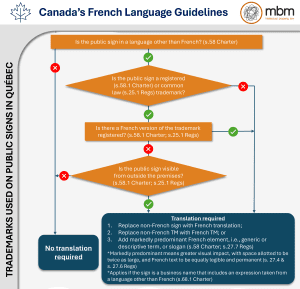
If you sell products or have public signage in the Province of Québec, then please consider what changes, if any, will be necessary to the product inscriptions/packaging and signage to ensure compliance with the amendments to the Charter of the French Language, c-11, which came into force on June 1, 2025.

To assist with your review, MBM has prepared the following flow charts:


MBM has developed creative solutions to minimize product inscriptions/packaging and signage changes and yet still be in compliance with the amendments to the Charter of the French Language, c-11, which came into force on June 1, 2025. The flow charts are provided only as a general guide based on known amendments to the Charter of the French Language, c-11. Future amendments or regulations may impact the information provided above.

If you would like to learn more or require any advice, please contact:

Scott Miller, Co-Managing Partner, Head of the Litigation Department
T: 613-801-1099
E:  smiller@mbm.com

Deborah Meltzer, Partner, Lawyer & Trademark Agent
T: 613-801-1077
E: dmeltzer@mbm.com


This article is general information only and is not to be taken as legal or professional advice. This article does not create a solicitor-client relationship between you and MBM Intellectual Property Law LLP. If you would like more information about intellectual property, please feel free to reach out to MBM for a free consultation.

Important CIPO Update – Amendments to Canadian Patent Rules

Canadian Intellectual Property Office (CIPO) just announced that the new amendments to the Canadian Patent Rules to ‘streamline examination’, including excess claim fees, will be coming into effect on October 3, 2022. The changes will include a $100/per claim fee for applications with more than 20 claims and a fee for continued examination after three office actions equal to the original examination fee. The amendments also add steps such as ‘notice of conditional allowance’.

As a result of these changes, we advise our clients to review their patent portfolios to determine which patents have over 20 claims and request examination for these patents before the October 3, 2022 date to avoid paying the access claim fees, as they would apply at the examination stage after this date.

We will follow up this announcement with more comprehensive coverage of the new changes to Canadian Patent Rules – stay tuned!


For more information please contact:

Claire Palmer, Ph.D., Senior Patent Agent
T: 613-801-0450
E: cpalmer@mbm.com

This article is general information only and is not to be taken as legal or professional advice. This article does not create a solicitor-client relationship between you and MBM Intellectual Property Law LLP. If you would like more information about intellectual property, please feel free to reach out to MBM for a free consultation.

Conference Posters and Materials: Beware! They Can Constitute Prior Art

In the academic world, it is common for researchers to attend and present their findings at conferences. Papers presented will typically end up as part of conference handouts or available online for future use. PowerPoint slides used in presentations are also sometimes published or distributed. Posters are often set up where attendees may view them. Conversations between researchers happen after presentations, and at numerous coffee breaks and networking events. In the publish or perish world of academia, conferences provide one of the best venues to present your ideas and research and meet with like-minded people.

Similarly, in the corporate world tradeshows are often used to show off products and demonstrate their features and capabilities to potential customers. Trade show booths often include demonstration systems, brochures, and marketing presentations that are only available for the two or three days of the show. Copies of brochures and presentations may be saved or may be destroyed afterwards.

Unfortunately, what is good for the sharing of information is often not good for the patenting of inventions that arise from the research and products presented at these conferences. The subject matter of a patent claim must not have been previously disclosed, and the invention must not be obvious to a person skilled in the art or science to which it pertains[1]. Conference presentations, presentation slides, and posters can all be prior art, whether they come from an inventor or someone else, and can prevent you from patenting your inventions.

Posters are an interesting case in that they may often be displayed for just a few hours, be viewed by passersby, and usually do not become part of the published conference proceedings. They are often untraceable or destroyed later. They often will not contain enough information to prevent an invention from being novel, but nevertheless may form part of the state of the art that must be considered when determining if an invention contains an inventive step.

In Biogen Canada Inc. v. Taro Pharmaceuticals Inc., 2020 FC 621, a poster was presented at a conference in Baltimore in 2002, 18 years previous. The poster was available to the court but had only been presented for a short time at the conference, and in the intervening years could not have been found even with a reasonably diligent search. Nevertheless, expert testimony established that the poster was indeed genuine and therefore its contents formed part of the state of the art in 2002 for determining obviousness of the patent claims in question. The poster, together with information found in other sources of prior art, were enough to find the patent claims in question obvious and invalid. This case is interesting since a poster, only presented for a short time at the conference and thereafter not being available, was used to establish the state of the prior art 18 years ago.

In Mediatube Corp. v. Bell Canada, 2017 FC 6 the plaintiff alleged that the defendant’s Fibe TV service could be modified to infringe its patents. Bell argued that all limitations of the relevant patent claims had been disclosed in a number of sources, including brochures and prototype systems that had been presented at the SuperComm tradeshow in June 1998, 19 years previous. Brochures were available to the court. Mediatube argued that the brochure was only disclosed at the tradeshow and could not be considered to have been available to the public as it could not later be found in a reasonably diligent search by a skilled person. With the help of expert testimony, the court decided that the brochures and presentations of the systems, despite only being available for a short time, were part of the state of the art at the time and could be considered when determining the validity of Mediatube’s patent claims.

On the other hand, in Valence Technology, Inc. v. Phostech Lithium Inc., 2011 FC 174, the defendant was challenging the validity of plaintiff’s patents. Phostech asserted that conference publications, presentations, and posters presented twelve years previous were prior art to at least some of the patent claims. The presenter had also had discussions while at the conference. The poster had since been destroyed and could not be presented to the court. When defining the common general knowledge at the key date the judge decided to exclude the presentations, posters, and any discussions that may have happened. Though not stated, this may have been because the poster had been destroyed and that there were no experts to testify to its contents or importance.

It is difficult to determine in advance if a poster will later be found to form part of the state of the art when considering patent validity. For prior art, such as a poster, that may only be presented for a few hours at a scientific or industry conference, it is uncertain whether it can be considered part of the body of prior art of which a person skilled in the art could be said to possess, especially since it may not be found later even through a reasonably diligent search. Like any disclosure, the best practice is to:

1. Review all public disclosures, even those that are short-lived and will be unavailable later.

2. Be careful what kind of information you put on a poster. Try to use more general information on all conference materials if possible.

3. If you must disclose detailed information, restrict any disclosures to individuals or groups in a non-public space under NDA.

4. File a provisional or utility patent application before the event.

5. Review and document what others present. Smartphones make it easy.

Better to be safe than sorry!

If you are considering filing a patent and are worried about your conference/event disclosure, please feel free to contact MBM for a free consultation.

T: 613-567-0762
E: patents@mbm.com


This article is general information only and is not to be taken as legal or professional advice. This article does not create a solicitor-client relationship between you and MBM Intellectual Property Law LLP. If you would like more information about intellectual property, please feel free to reach out to MBM for a free consultation.

[1] Canadian Patent Act 28.2 and 28.3. https://laws-lois.justice.gc.ca/eng/acts/P-4/page-10.html#docCont

Software and Business Method Patents – How to Improve Your Chances?

Some of the most valuable inventions are software implemented methods. Many software methods are business method patents designed to make business more efficient. These include Artificial Intelligence (AI) / machine learning applications and Financial Technology (Fintech) applications.

Software patents, historically, were not considered patentable. This is because mathematical algorithms (scientific principles and abstract theorems) are generally not patentable in Canada and computer programs were seen as simply an implementation of mathematical algorithms and formulas. As the patent office historically stated, if an invention did not have a physical existence or manifest a discernible physical effect or change, you could not patent it.

This changed in 2010 with the granting of the Amazon 1-click patent. Subsequently, the Canadian Intellectual Property Office (CIPO) updated their Examination practice guidance to say that given a purposive claim construction, if a computer (to execute the software) was found to be an essential element, the combination of the computer and the software, being a tangible device, could be patented.

Purposive claim construction was defined by the Supreme Court of Canada in 2000 and a two-part test was developed to determine if a claim element was essential or non-essential. A claim element is essential if:

  • Modifying or substituting the claim element would change the way the invention works
  • The inventor intended that the claim element be essential

If a claim element is essential, the patent Examiner must consider it. If a claim element is non-essential, a patent Examiner may ignore it.

Unfortunately, the guidance from CIPO only cited the first part of the test and omitted the second. This meant that many computer-implemented claims were rejected because the Examiner would determine that the computer was non-essential, ignore it, and be left with only the computer algorithm. The remaining algorithm would then be found to be an abstract theorem and be rejected.

This changed at the end of 2020 when the Federal Court ruled that CIPO’s guidance goes against the Supreme Court’s two-part test. Recently, CIPO has issued new guidance so that the full two-part test for determining essential and non-essential claim elements will be used.

This is great news for inventors and companies innovating in the field of software, financial, and business methods. No longer can the patent office so easily ignore the physical aspects of your inventions and reject your patents.

To ensure that your software inventions can be patented there are several steps you can take:

1. Make sure that there are physical elements in your claims that are essential elements. There must be an essential physical aspect of your invention. Your patent professionals can help you with this.

2. Your invention should provide a technical solution to a technical problem. It is best that your invention produces a physical effect or change.

3. If your invention improves the operation or efficiency of the computer itself, this should be highlighted.

4. Describe the physical environment in which the software operates. Don’t just describe the mathematical algorithm; include the computers, the network, servers, and the external world in which it operates.

5. If your system obtains data from external sensors or uses the results to control something in the real world, include these details.

If you have a software invention that you are considering patenting, please feel free to reach out to MBM for a free consultation.

T: 613-567-0762

E: patents@mbm.com


This article is general information only and is not to be taken as legal or professional advice. This article does not create a solicitor-client relationship between you and MBM Intellectual Property Law LLP. If you would like more information about intellectual property, please feel free to reach out to MBM for a free consultation.

Federal Court Finds CIPO Examination Practice Out of Line with Supreme Court Precedents

The Federal Court in a recent decision found a wide-reaching examination practice respecting purposive construction that was introduced by The Canadian Intellectual Property Office (CIPO) 7 years ago, to be against principles of purposive construction set forth by the Supreme Court and damaging to the prosecution of patents in several technology areas.

CIPO issued practice notice PN2013-02 entitled “Examination Practice Respecting Purposive Construction” on March 8, 2013 that instructed Examiners to frame their purposive construction of the claims through a problem and solution lens. In particular, it was CIPO’s position in this practice notice that “identification of the problem and the solution provided by the invention informs the purposive construction of the claims” and that only those elements that solved the identified problem were essential.

A second practice notice (PN2013-03) entitled Examination Practice Respecting Computer-Implemented Inventions was also issued that detailed using the problem and solution framed “purposive construction” for the examination of applications directed to computer implemented methods.

Two subsequent practice notices (PN2015-01 and PN2015-02) were also issued that detailed using the problem and solution framed “purposive construction” for the examination of applications directed to medical uses and medical diagnostic methods.

These CIPO practices significantly and negatively impacted prosecution in many areas of technology including computer implement methods, personalized medicine, diagnostics and biotechnology. In fact, to date, there have been 31 Patent Appeal Board decisions that referenced practice notice PN2013-02, ten of which included statutory subject matter objections. Of these ten, seven were refused outright.

There were also 84 Patent Appeal Board decisions that referenced practice notice PN2013-03 and 8 Patent Appeal Board decisions that reference practice notice PN2015-01.

The Federal Court in the recent Choueifaty v. Canada (Attorney General) decision (2020 FC 837) turned their eyes to CIPO’s practice of using the problem and the solution approach to inform purposive construction of the claims. This decision specifically reviewed Patent Appeal Board decision 1478 that specifically referenced PN 2013-03. Although Choueifaty v. Canada does not specifically reference the practice notices, the Court referenced the Manual of Patent of Practice 13.05.02 which incorporated the content of practice notice PN2013-02. The Court found:

[31] It is evident on a reading of the MOPOP that the Commissioner, notwithstanding stating that the patent claims are to be construed in a purposive manner, does not intend or direct patent examiners to follow the teachings of Free World Trust and Whirlpool

[37] The Appellant submits, and I agree, that using the problem-solution approach to claims construction is akin to using the “substance of the invention” approach discredited by the Supreme Court of Canada in Free World Trust at para 46. …

[40] For these reasons, I find that the Commissioner erred in determining the essential elements of the claimed invention by using the problem-solution approach, rather than the approach Whirlpool directs be used. (Emphasis added)

MBM welcomes this decision from the Federal Court that affirms our longstanding position that CIPO’s problem and solution framed “purposive construction” was inconsistent with the principles set forth by the Supreme Court of Canada.

For more information please contact:

Kay Palmer, Ph.D., Senior Patent Agent
T: 613-801-0452
E: kpalmer@mbm.com

Claire Palmer, Ph.D., Senior Patent Agent
T: 613-801-0450
E: cpalmer@mbm.com


This article is general information only and is not to be taken as legal or professional advice. This article does not create a solicitor-client relationship between you and MBM Intellectual Property Law LLP. If you would like more information about intellectual property, please feel free to reach out to MBM for a free consultation.


No success for Questor in its quest for an injunction

QUESTOR TECHNOLOGY INC V STAGG, 2020 ABQB 3

Despite whatever the clauses in employment agreements may read, an injunction will likely not be granted if it does not seem fair and equitable to do so.

In this decision, while the Court of Queen’s Bench of Alberta (the “ABQB”) declined to issue an injunction in favour of Questor Technology Inc (“Questor”), it did order former employees of Questor (the “Defendants”) to return to Questor any and all confidential information they had taken from Questor in breach of their employment contracts.

BACKGROUND

Questor, an environmental technology company, is in the business of selling custom incinerators, used primarily in the oil and gas industry for burning waste gasses like methane. The Defendants had designed a low-pressure waste gas combustion solution for Questor, while employed by Questor. However, after departing from Questor, the Defendants launched a company of their own, offering a competing low-pressure waste gas incinerator (the “Competing Technology”).

Questor asserts it is the owner of the Competing Technology by way of either: (i) terms of the employment contracts signed by the Defendants, or (ii) application of the common law. As such, Questor sought an injunction against the Defendants from aspects such as competing in the market against Questor, or infringing Questor’s intellectual property (“IP”) – Questor claimed it owned the IP relating to the Competing Technology.

The sole issue in this decision was determining whether an interim injunction ought to be granted in favour of Questor against the Defendants.

ANALYSIS

The ABQB ran through the test in RJR-MacDonald Inc v Canada (AG), [1994] 1 SCR 311 to determine whether an injunction ought to be granted. The test would require Questor to demonstrate: (a) that there is a serious issue to be tried; (b) that Questor will suffer irreparable harm if the application is refused; and (c) that the balance of convenience weighs in favour of granting the injunction. However, the ABQB found that this case was an exception, where a higher standard would apply for the first element of the test, namely that Questor would need to establish a strong prima facie case.

A detailed analysis of the Defendants actions led the ABQB to determine that Questor had not established a strong prima facie case for the injunction. Similarly, the ABQB was unconvinced that Questor had clearly proven that it would suffer irreparable harm if the injunction were not granted. Finally, the balance of convenience seemed to favour the Defendants, as an injunction would shut down everything they had built, while Questor, a larger, publicly-traded company, would likely be unaffected if the injunction was denied.

The ABQB remarked that as injunctions are an equitable remedy, it would not be fair and just to issue one in those circumstances.

COMMENTARY

Different areas of the law are often much more interconnected than people may believe. Obligations to confidential information, employment agreements and assignments of inventions all affect IP rights. While the ABQB did not answer questions like whether Questor was the rightful owner of the Competing Technology, the questions themselves still played a key role in determining the outcome of the case. Even if relevant IP questions had been answered, it would still likely have been unjust to grant an injunction in this case.

If you are dealing with a legal issue where IP may be involved, please feel free to reach out to MBM for a free consultation.

T: 613-567-0762
E: general@mbm.com

Authors: Osman Ismaili, Patent Associate


This article is general information only and is not to be taken as legal or professional advice. This article does not create a solicitor-client relationship between you and MBM Intellectual Property Law LLP. If you would like more information about intellectual property, please feel free to reach out to MBM for a free consultation.
Top Top