To Translate or not to Translate? MBM Provides General Guide for Businesses Operating in the Province of Québec after June 1, 2025

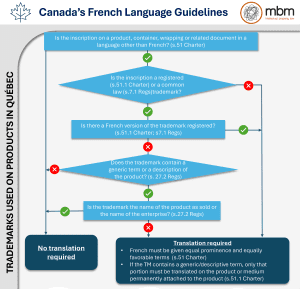
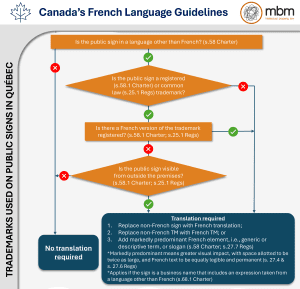
If you sell products or have public signage in the Province of Québec, then please consider what changes, if any, will be necessary to the product inscriptions/packaging and signage to ensure compliance with the amendments to the Charter of the French Language, c-11, which came into force on June 1, 2025.

To assist with your review, MBM has prepared the following flow charts:


MBM has developed creative solutions to minimize product inscriptions/packaging and signage changes and yet still be in compliance with the amendments to the Charter of the French Language, c-11, which came into force on June 1, 2025. The flow charts are provided only as a general guide based on known amendments to the Charter of the French Language, c-11. Future amendments or regulations may impact the information provided above.

If you would like to learn more or require any advice, please contact:

Scott Miller, Co-Managing Partner, Head of the Litigation Department
T: 613-801-1099
E:  smiller@mbm.com

Deborah Meltzer, Partner, Lawyer & Trademark Agent
T: 613-801-1077
E: dmeltzer@mbm.com


This article is general information only and is not to be taken as legal or professional advice. This article does not create a solicitor-client relationship between you and MBM Intellectual Property Law LLP. If you would like more information about intellectual property, please feel free to reach out to MBM for a free consultation.

New Trademark Laws For Québec – What You Need To Know

In approximately three years or less, the Québec Government’s newly adopted Bill 96, An Act respecting French, the official and common language of Québec will go into force. Bill 96 will have a significant impact on the use of English trademarks in the Province of Québec. For example, whereas in the past, both unregistered and registered trademarks did not need to be translated into French, under Bill 96, only registered trademarks will be exempt from translation into French. Currently, it takes approximately two years for a trademark application to mature to registration in Canada. As such, it is imperative businesses review their trademark portfolios and consider which trademarks ought to be filed for registration to ensure continued use in the Province of Québec.

The Present Rules in Québec:

Promotional Material/Packaging
At present, a “recognized trademark” is exempt from translation requirements in Québec. A recognized trademark includes a registered trademark, an applied-for trademark with a pending application, or a common law trademark. As such, unless the English trademark has been registered in French, it is not necessary to translate the English trademark registered or common law (unregistered) on packaging offered in Québec into French.

Signage
Currently, in Québec, outside signage, inside signage that is seen outside, mall signage and/or signage on a pole/column (with some exceptions) displaying an English registered or common law (unregistered) trademark does not need to be translated into French. However, if the equivalent French trademark is a registered trademark, then the French trademark must be used on the signage. In any event, if there is only an English trademark, unlike packaging or promotional material, the signage must have “sufficient presence” in French and include:[1]

  • A generic term or a description of the products or services;
  • A slogan; or
  • Any other term or indication favouring the display of information pertaining to the products or services to the benefit of consumers or persons frequenting the site (location).

The “sufficient presence” of French means that it should be displayed with permanent visibility and legibility in the same visual field as the non-French mark, although not necessary to be present side-by-side, in the same number, in the same materials or in the same size.[2]

Exception: If the English trademark is displayed on a pole/column and there are more than two trademarks on the pole/column then the signage does not need to disclose the generic term, slogan or other terms in French.  The typical situation would be the external signage of the parking lot entrance for an outdoor mall.[3]

Bill 96 – New Requirements in Québec for French in Trademarks:

When Bill 96 goes into effect, the scope of the “recognized trademark” exemption is greatly reduced.

First, only non-French registered trademarks will be exempt and not need to be translated into French. As such, an unregistered (i.e., applied-for or common law) English trademark will need to be accompanied by its French equivalent on commercial advertising and public signage.

Second, even if a non-French trademark is registered but is used on public signs and posters visible from the outside of a premise, the signage must still have a generic term, slogan or other term in French marked predominately in French.[4] Predominantly means that the space allotted to the French text must be at least twice as large as the space allotted to the non-French text, or the characters used in the French text must be at least twice as large as those used in the non-French text.[5]

Implications of the New Québec Language Laws:

It is expected that the newly adopted Québec language laws will be in force in three years or less.  Currently, it takes approximately two years for a trademark application to mature to registration in Canada. As such, if you offer goods and/or services in Québec and do not want to run afoul of the new Québec language laws, then it is imperative for you to review your trademark portfolios and consider a tailored solution to meet your business goals (for example, filing trademark applications with the Canadian Intellectual Property Office immediately).

Notably, these implications may not only affect English language trademarks but also trademarks using other non-French languages and potentially “coined” words.


For more information, please contact:
Scott Miller, Co-Managing Partner, Head of the Litigation Department
T: 613-801-1099
E: smiller@mbm.com


This article is general information only and is not to be taken as legal or professional advice. This article does not create a solicitor-client relationship between you and MBM Intellectual Property Law LLP. If you would like more information about intellectual property, please feel free to reach out to MBM for a free consultation.


[1] Regulation respecting the language of commerce and business, CQLR c C-11, r 9, ss 25(4) and 25.1.
[2] CQLR c C-11, r 9, s 25.3.
[3] CQLR c C-11, r 9, s 25.2(1).
[4] Bill 96, An Act respecting French, the official and common language of Québec, 1st Sess, 42nd Leg, Québec, 2021, cl 47 (assented to 1 June 2022).
[5] CQLR c C-11, r 11.

Conference Posters and Materials: Beware! They Can Constitute Prior Art

In the academic world, it is common for researchers to attend and present their findings at conferences. Papers presented will typically end up as part of conference handouts or available online for future use. PowerPoint slides used in presentations are also sometimes published or distributed. Posters are often set up where attendees may view them. Conversations between researchers happen after presentations, and at numerous coffee breaks and networking events. In the publish or perish world of academia, conferences provide one of the best venues to present your ideas and research and meet with like-minded people.

Similarly, in the corporate world tradeshows are often used to show off products and demonstrate their features and capabilities to potential customers. Trade show booths often include demonstration systems, brochures, and marketing presentations that are only available for the two or three days of the show. Copies of brochures and presentations may be saved or may be destroyed afterwards.

Unfortunately, what is good for the sharing of information is often not good for the patenting of inventions that arise from the research and products presented at these conferences. The subject matter of a patent claim must not have been previously disclosed, and the invention must not be obvious to a person skilled in the art or science to which it pertains[1]. Conference presentations, presentation slides, and posters can all be prior art, whether they come from an inventor or someone else, and can prevent you from patenting your inventions.

Posters are an interesting case in that they may often be displayed for just a few hours, be viewed by passersby, and usually do not become part of the published conference proceedings. They are often untraceable or destroyed later. They often will not contain enough information to prevent an invention from being novel, but nevertheless may form part of the state of the art that must be considered when determining if an invention contains an inventive step.

In Biogen Canada Inc. v. Taro Pharmaceuticals Inc., 2020 FC 621, a poster was presented at a conference in Baltimore in 2002, 18 years previous. The poster was available to the court but had only been presented for a short time at the conference, and in the intervening years could not have been found even with a reasonably diligent search. Nevertheless, expert testimony established that the poster was indeed genuine and therefore its contents formed part of the state of the art in 2002 for determining obviousness of the patent claims in question. The poster, together with information found in other sources of prior art, were enough to find the patent claims in question obvious and invalid. This case is interesting since a poster, only presented for a short time at the conference and thereafter not being available, was used to establish the state of the prior art 18 years ago.

In Mediatube Corp. v. Bell Canada, 2017 FC 6 the plaintiff alleged that the defendant’s Fibe TV service could be modified to infringe its patents. Bell argued that all limitations of the relevant patent claims had been disclosed in a number of sources, including brochures and prototype systems that had been presented at the SuperComm tradeshow in June 1998, 19 years previous. Brochures were available to the court. Mediatube argued that the brochure was only disclosed at the tradeshow and could not be considered to have been available to the public as it could not later be found in a reasonably diligent search by a skilled person. With the help of expert testimony, the court decided that the brochures and presentations of the systems, despite only being available for a short time, were part of the state of the art at the time and could be considered when determining the validity of Mediatube’s patent claims.

On the other hand, in Valence Technology, Inc. v. Phostech Lithium Inc., 2011 FC 174, the defendant was challenging the validity of plaintiff’s patents. Phostech asserted that conference publications, presentations, and posters presented twelve years previous were prior art to at least some of the patent claims. The presenter had also had discussions while at the conference. The poster had since been destroyed and could not be presented to the court. When defining the common general knowledge at the key date the judge decided to exclude the presentations, posters, and any discussions that may have happened. Though not stated, this may have been because the poster had been destroyed and that there were no experts to testify to its contents or importance.

It is difficult to determine in advance if a poster will later be found to form part of the state of the art when considering patent validity. For prior art, such as a poster, that may only be presented for a few hours at a scientific or industry conference, it is uncertain whether it can be considered part of the body of prior art of which a person skilled in the art could be said to possess, especially since it may not be found later even through a reasonably diligent search. Like any disclosure, the best practice is to:

1. Review all public disclosures, even those that are short-lived and will be unavailable later.

2. Be careful what kind of information you put on a poster. Try to use more general information on all conference materials if possible.

3. If you must disclose detailed information, restrict any disclosures to individuals or groups in a non-public space under NDA.

4. File a provisional or utility patent application before the event.

5. Review and document what others present. Smartphones make it easy.

Better to be safe than sorry!

If you are considering filing a patent and are worried about your conference/event disclosure, please feel free to contact MBM for a free consultation.

T: 613-567-0762
E: patents@mbm.com


This article is general information only and is not to be taken as legal or professional advice. This article does not create a solicitor-client relationship between you and MBM Intellectual Property Law LLP. If you would like more information about intellectual property, please feel free to reach out to MBM for a free consultation.

[1] Canadian Patent Act 28.2 and 28.3. https://laws-lois.justice.gc.ca/eng/acts/P-4/page-10.html#docCont

Enforcing Copyright Outside the Courtroom – The New Notice Regimes

With the ever-increasing presence of social media, including websites like YouTube where content can generate income, copyright infringement is escalating at alarming rates. Unfortunately, it is no secret that the cost of enforcing copyright through the courts is expensive. To mitigate these costs, this article will provide some tips on how to enforce copyright outside the courtroom.

Enforcing Copyright

The traditional pre-litigation enforcement tool is a demand letter. However, consideration should also be given to the Copyright Act ‘Notice and Notice Regime’ and where applicable, the social media platform(s) internal notice systems.

Traditional Pre-Litigation Demand Letters

Obviously, the stronger the identity of a right is explained in a demand letter the more likely the letter will have an effect. Fortunately, obtaining a copyright registration is extremely quick and relatively inexpensive. As such, consideration should be given to whether to register a copyright before the delivery of a demand letter.

Pre-Litigation Notice Letters

To avoid litigation, the federal government and social media platforms have created an alternate pathway to enforce copyright and settle disputes.

Notice and Notice Regime

To deal with growing copyright infringement that occurs via intermediaries without initiating litigation, the federal government added section 41.25, to the Copyright Act, which sets up the Notice and Notice Regime.

The Notice and Notice Regime is a voluntary-industry based system in which copyright owners can notify an intermediary, including social media platforms, that they are hosting copyright infringing material. The social media platform would then notify the copyright violator, usually by forwarding the letter they have received. Additionally, intermediaries are obligated to retain records about the alleged copyright infringement for six months after the notice is issued. Intermediaries commonly include internet service providers (ISPs).

Automatic Forwarding

Unfortunately, the original system was subject to abuse as social media platforms tended to forward all copyright notices they received in order to limit their liability. Copyright trolls and other nefarious entities would bulk mail, and email, standardized letters to social media platforms, which they would forward to the alleged infringers. These letters were used to effectively extort settlement money from alleged infringers.

To prevent this abuse, the federal government amended section 41.25 (3) of the Copyright Act to prohibit these notices from containing:

  • An offer to settle the claimed infringement;
  • A request or demand, made in relation to the claimed infringement, for payment or for personal information;
  • A reference, including by way of hyperlink, to such an offer, request or demand; and
  • Any other information that may be prescribed by regulation.

If a notice containing any of the above is sent to an intermediary, they are no longer obligated to forward the notice or maintain any records of it. However, in practice, social media companies often still forward these notices without reviewing them. Therefore, it is important to determine the actual source of the notice and its content.

Internal Notice System

Virtually all social media platforms have developed their own copyright notice systems and policies to deal with and notify alleged copyright violators. However, YouTube and other social media platforms send out many different types of notices. Each different type of notice can result in different consequences. Thus, it is important to identify not only: (a) who is sending the notice (e.g. a lawyer, social media platform or alleged copyright holder); but also (b) what type of notice is being sent. Only after knowing both, who the sender is and what type of notice it is, can a recipient better understand the proper actions to take.

It is important to remember that regardless how far a copyright holder is along the notice path, copyright holders can still initiate legal action separately and independently at any time. The copyright holder always has the option to initiate legal proceedings.

If you are considering sending a cease and desist letter relating to intellectual property infringement, or if you have received such a letter, please feel free to reach out to MBM for a free consultation. Also, stay tuned for a separate article discussing specifically YouTube’s internal controls for IP infringement.

For more information, please contact:

T: 613-567-0762
E: general@mbm.com

This article is general information only and is not to be taken as legal or professional advice. This article does not create a solicitor-client relationship between you and MBM Intellectual Property Law LLP. If you would like more information about intellectual property, please feel free to reach out to MBM for a free consultation.

Unauthorized Photographs: The Rights Of The People We Capture

We live in the digital age of smartphones and social media, where the large scale capturing and sharing of photographs has become a global run-of-the-mill form of communication and expression. The rights in these photographs are typically subject to the licensing schemes of the various social media platforms to which they are posted. This is because the authors of these works, the photographers, own copyright in the images they create. However, on the other side of the lens, what frequently gets overlooked are the rights of the people in the photographs as opposed to the ones taking it. This is not an unfamiliar concept. For instance, the Duke and Duchess of Sussex have recently made headlines regarding the unauthorized use of their image by various media outlets.

When it comes to celebrities and other public figures, the laws across Canada have established various personality rights to protect these individuals from the exploitation of their image or likeness. That said, the law is less clear as to the particular rights of private citizens who are the subject of an image to which they did not consent. In Canada, the use of an individual’s image can be unlawful where:

(a) an individual’s name, reputation, or likeness is commercially exploited; or

(b) an individual’s right to privacy has been violated

These wrongs are actionable under the tort of appropriation of personality and provincial privacy torts.

COMMERCIAL EXPLOITATION OF AN IMAGE OR LIKENESS

The tort of appropriation of personality most commonly protects the right of a celebrity or other public figure against the use of their image or likeness for a commercial purpose without their consent. This stems from the idea that a person should have the exclusive right to market and/or capitalize on their personality and image. This is of course subject to certain exceptions (e.g., biographies, plays, books, etc.) where the purpose is to provide insight into that individual (see for example Gould Estate v Stoddard Publishing, [1998] O.J. No. 1894 (ONCA)).

The case law has established that to succeed in the tort of appropriation of personality, the following criteria must be met:

1. The use of the image or likeness must be for a commercial purpose (see Athans v Canadian Adventure Camps Ltd. [1977] O.J. No. 2417 (Ontario Supreme Court); and

2. The individual (plaintiff) must be clearly and primarily captured in the image (see Krouse v Chrysler Canada Ltd. et al., 13 C.P.R. (2d) 28 (1973 ONCA))

While this tort is technically available to non-famous people, it is obviously less likely that an image of a person without notoriety would be commercially exploited. That said, with respect to individuals with professional designations, their professional reputation is protected under the right of personality. For instance, in Hay v Platinum Equities Inc. 2012 ABQB 204, an accountant’s signature was unlawfully used to secure financing for a loan and the Court held that professional reputation for commercial exploitation is akin to celebrity name and likeness.

PRIVACY RIGHTS

In Canada, individuals have the right to a reasonable expectation of privacy. There is a distinction between “personality” – the exclusive right to use your likeness for commercial gain, and “privacy” – the rights of seclusion and the protection of personal information. These concepts, although often intertwined, are legally distinct; a breach of privacy causes personal harm while an appropriation of personality causes commercial harm.

With respect to privacy rights, in Jones v Tsige, 2012 ONCA 32 (“Tsige”), the Ontario Court of Appeal recognized that the tort of “intrusion upon seclusion” exists in Ontario. In that case, the defendant had used her access as a bank employee to view the plaintiff’s banking information over 150 times over a 4-year period. The required elements to satisfy the tort were defined as follows:

1. The defendant’s conduct must have been intentional (this includes recklessness);

2. There must be an “intrusion” – the defendant must have invaded, without lawful justification, the plaintiff’s private affairs or concerns; and

3. The invasion must be highly offensive to a reasonable person (i.e., causing distress, humiliation, or anguish).

Additionally, the Court stressed that proof of harm to a recognized economic interest is not an element of the cause of action. This means that no actual damage or commercial exploitation is required in establishing intrusion upon seclusion. It is sufficient that the privacy of the plaintiff was egregiously violated.

In relation to control over a person’s image, over 20 years ago in Aubry c. Vice Versa Publishing Inc. [1998] 1 SCR 591 (“Aubry”), the Supreme Court of Canada recognized that the right to one’s own image falls within the right to privacy under section 5 of the Quebec Charter of Human Rights and Freedoms. In this case, the defendant published a picture in a magazine of a woman in a public space, with no defamatory implications in the context of the image or magazine content. However, since the individual was clearly identifiable and her permission was not sought prior to publication, a majority on the Court concluded that the freedom of artistic expression did not justify the infringement of the right to privacy.

Although the civil remedy in Aubry is particular to Quebec in light of the broad scope of the Quebec Charter, the Supreme Court’s determination is nevertheless important because it exemplified that the protection of a person’s image forms part of their personal privacy interest.

In Ontario, in Jane Doe 72511 v Morgan, 2018 ONSC 6607, relying on the reasoning in Tsige, the Ontario Superior Court of Justice adopted the tort of public disclosure of private facts. In that case, the defendant was the ex-boyfriend of the plaintiff, who posted unauthorized intimate/nude photos and videos of the plaintiff on a public website that was viewed over 60,000 times. Paramount to this finding was that the act of publication was highly offensive and not of legitimate concern to the public.

CONCLUSION

As referenced in Tsige, legal scholars have written of “the pressing need to preserve ‘privacy’ which is being threatened by science and technology to the point of surrender”. The exponential growth of social media platforms and smartphone usage is generating unprecedented privacy concerns which are outpacing current statutory and common law privacy rights. Until Canadian and provincial laws catch-up, photographers and social media users should understand that what they capture, more importantly who they capture, may, one way or another, intrude on someone’s rights. Regardless, when snapping a photo, photographers should exercise best practice and ask for consent of the people they capture.


For more information please contact:

Deborah Meltzer, Partner, Lawyer, & Trademark Agent
T: 613-801-1077
E: dmeltzer@mbm.com

This article is general information only and is not to be taken as legal or professional advice. This article does not create a solicitor-client relationship between you and MBM Intellectual Property Law LLP. If you would like more information about intellectual property, please feel free to reach out to MBM for a free consultation.
Top Top