To Translate or not to Translate? MBM Provides General Guide for Businesses Operating in the Province of Québec after June 1, 2025

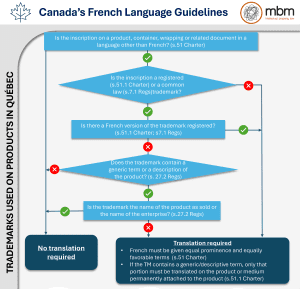
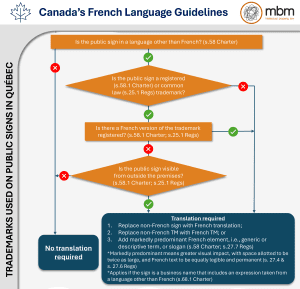
If you sell products or have public signage in the Province of Québec, then please consider what changes, if any, will be necessary to the product inscriptions/packaging and signage to ensure compliance with the amendments to the Charter of the French Language, c-11, which came into force on June 1, 2025.

To assist with your review, MBM has prepared the following flow charts:


MBM has developed creative solutions to minimize product inscriptions/packaging and signage changes and yet still be in compliance with the amendments to the Charter of the French Language, c-11, which came into force on June 1, 2025. The flow charts are provided only as a general guide based on known amendments to the Charter of the French Language, c-11. Future amendments or regulations may impact the information provided above.

If you would like to learn more or require any advice, please contact:

Scott Miller, Co-Managing Partner, Head of the Litigation Department
T: 613-801-1099
E:  smiller@mbm.com

Deborah Meltzer, Partner, Lawyer & Trademark Agent
T: 613-801-1077
E: dmeltzer@mbm.com


This article is general information only and is not to be taken as legal or professional advice. This article does not create a solicitor-client relationship between you and MBM Intellectual Property Law LLP. If you would like more information about intellectual property, please feel free to reach out to MBM for a free consultation.

New Trademark Laws For Québec – What You Need To Know

In approximately three years or less, the Québec Government’s newly adopted Bill 96, An Act respecting French, the official and common language of Québec will go into force. Bill 96 will have a significant impact on the use of English trademarks in the Province of Québec. For example, whereas in the past, both unregistered and registered trademarks did not need to be translated into French, under Bill 96, only registered trademarks will be exempt from translation into French. Currently, it takes approximately two years for a trademark application to mature to registration in Canada. As such, it is imperative businesses review their trademark portfolios and consider which trademarks ought to be filed for registration to ensure continued use in the Province of Québec.

The Present Rules in Québec:

Promotional Material/Packaging
At present, a “recognized trademark” is exempt from translation requirements in Québec. A recognized trademark includes a registered trademark, an applied-for trademark with a pending application, or a common law trademark. As such, unless the English trademark has been registered in French, it is not necessary to translate the English trademark registered or common law (unregistered) on packaging offered in Québec into French.

Signage
Currently, in Québec, outside signage, inside signage that is seen outside, mall signage and/or signage on a pole/column (with some exceptions) displaying an English registered or common law (unregistered) trademark does not need to be translated into French. However, if the equivalent French trademark is a registered trademark, then the French trademark must be used on the signage. In any event, if there is only an English trademark, unlike packaging or promotional material, the signage must have “sufficient presence” in French and include:[1]

  • A generic term or a description of the products or services;
  • A slogan; or
  • Any other term or indication favouring the display of information pertaining to the products or services to the benefit of consumers or persons frequenting the site (location).

The “sufficient presence” of French means that it should be displayed with permanent visibility and legibility in the same visual field as the non-French mark, although not necessary to be present side-by-side, in the same number, in the same materials or in the same size.[2]

Exception: If the English trademark is displayed on a pole/column and there are more than two trademarks on the pole/column then the signage does not need to disclose the generic term, slogan or other terms in French.  The typical situation would be the external signage of the parking lot entrance for an outdoor mall.[3]

Bill 96 – New Requirements in Québec for French in Trademarks:

When Bill 96 goes into effect, the scope of the “recognized trademark” exemption is greatly reduced.

First, only non-French registered trademarks will be exempt and not need to be translated into French. As such, an unregistered (i.e., applied-for or common law) English trademark will need to be accompanied by its French equivalent on commercial advertising and public signage.

Second, even if a non-French trademark is registered but is used on public signs and posters visible from the outside of a premise, the signage must still have a generic term, slogan or other term in French marked predominately in French.[4] Predominantly means that the space allotted to the French text must be at least twice as large as the space allotted to the non-French text, or the characters used in the French text must be at least twice as large as those used in the non-French text.[5]

Implications of the New Québec Language Laws:

It is expected that the newly adopted Québec language laws will be in force in three years or less.  Currently, it takes approximately two years for a trademark application to mature to registration in Canada. As such, if you offer goods and/or services in Québec and do not want to run afoul of the new Québec language laws, then it is imperative for you to review your trademark portfolios and consider a tailored solution to meet your business goals (for example, filing trademark applications with the Canadian Intellectual Property Office immediately).

Notably, these implications may not only affect English language trademarks but also trademarks using other non-French languages and potentially “coined” words.


For more information, please contact:
Scott Miller, Co-Managing Partner, Head of the Litigation Department
T: 613-801-1099
E: smiller@mbm.com


This article is general information only and is not to be taken as legal or professional advice. This article does not create a solicitor-client relationship between you and MBM Intellectual Property Law LLP. If you would like more information about intellectual property, please feel free to reach out to MBM for a free consultation.


[1] Regulation respecting the language of commerce and business, CQLR c C-11, r 9, ss 25(4) and 25.1.
[2] CQLR c C-11, r 9, s 25.3.
[3] CQLR c C-11, r 9, s 25.2(1).
[4] Bill 96, An Act respecting French, the official and common language of Québec, 1st Sess, 42nd Leg, Québec, 2021, cl 47 (assented to 1 June 2022).
[5] CQLR c C-11, r 11.

Important CIPO Update – Amendments to Canadian Patent Rules

Canadian Intellectual Property Office (CIPO) just announced that the new amendments to the Canadian Patent Rules to ‘streamline examination’, including excess claim fees, will be coming into effect on October 3, 2022. The changes will include a $100/per claim fee for applications with more than 20 claims and a fee for continued examination after three office actions equal to the original examination fee. The amendments also add steps such as ‘notice of conditional allowance’.

As a result of these changes, we advise our clients to review their patent portfolios to determine which patents have over 20 claims and request examination for these patents before the October 3, 2022 date to avoid paying the access claim fees, as they would apply at the examination stage after this date.

We will follow up this announcement with more comprehensive coverage of the new changes to Canadian Patent Rules – stay tuned!


For more information please contact:

Claire Palmer, Ph.D., Senior Patent Agent
T: 613-801-0450
E: cpalmer@mbm.com

This article is general information only and is not to be taken as legal or professional advice. This article does not create a solicitor-client relationship between you and MBM Intellectual Property Law LLP. If you would like more information about intellectual property, please feel free to reach out to MBM for a free consultation.

Conference Posters and Materials: Beware! They Can Constitute Prior Art

In the academic world, it is common for researchers to attend and present their findings at conferences. Papers presented will typically end up as part of conference handouts or available online for future use. PowerPoint slides used in presentations are also sometimes published or distributed. Posters are often set up where attendees may view them. Conversations between researchers happen after presentations, and at numerous coffee breaks and networking events. In the publish or perish world of academia, conferences provide one of the best venues to present your ideas and research and meet with like-minded people.

Similarly, in the corporate world tradeshows are often used to show off products and demonstrate their features and capabilities to potential customers. Trade show booths often include demonstration systems, brochures, and marketing presentations that are only available for the two or three days of the show. Copies of brochures and presentations may be saved or may be destroyed afterwards.

Unfortunately, what is good for the sharing of information is often not good for the patenting of inventions that arise from the research and products presented at these conferences. The subject matter of a patent claim must not have been previously disclosed, and the invention must not be obvious to a person skilled in the art or science to which it pertains[1]. Conference presentations, presentation slides, and posters can all be prior art, whether they come from an inventor or someone else, and can prevent you from patenting your inventions.

Posters are an interesting case in that they may often be displayed for just a few hours, be viewed by passersby, and usually do not become part of the published conference proceedings. They are often untraceable or destroyed later. They often will not contain enough information to prevent an invention from being novel, but nevertheless may form part of the state of the art that must be considered when determining if an invention contains an inventive step.

In Biogen Canada Inc. v. Taro Pharmaceuticals Inc., 2020 FC 621, a poster was presented at a conference in Baltimore in 2002, 18 years previous. The poster was available to the court but had only been presented for a short time at the conference, and in the intervening years could not have been found even with a reasonably diligent search. Nevertheless, expert testimony established that the poster was indeed genuine and therefore its contents formed part of the state of the art in 2002 for determining obviousness of the patent claims in question. The poster, together with information found in other sources of prior art, were enough to find the patent claims in question obvious and invalid. This case is interesting since a poster, only presented for a short time at the conference and thereafter not being available, was used to establish the state of the prior art 18 years ago.

In Mediatube Corp. v. Bell Canada, 2017 FC 6 the plaintiff alleged that the defendant’s Fibe TV service could be modified to infringe its patents. Bell argued that all limitations of the relevant patent claims had been disclosed in a number of sources, including brochures and prototype systems that had been presented at the SuperComm tradeshow in June 1998, 19 years previous. Brochures were available to the court. Mediatube argued that the brochure was only disclosed at the tradeshow and could not be considered to have been available to the public as it could not later be found in a reasonably diligent search by a skilled person. With the help of expert testimony, the court decided that the brochures and presentations of the systems, despite only being available for a short time, were part of the state of the art at the time and could be considered when determining the validity of Mediatube’s patent claims.

On the other hand, in Valence Technology, Inc. v. Phostech Lithium Inc., 2011 FC 174, the defendant was challenging the validity of plaintiff’s patents. Phostech asserted that conference publications, presentations, and posters presented twelve years previous were prior art to at least some of the patent claims. The presenter had also had discussions while at the conference. The poster had since been destroyed and could not be presented to the court. When defining the common general knowledge at the key date the judge decided to exclude the presentations, posters, and any discussions that may have happened. Though not stated, this may have been because the poster had been destroyed and that there were no experts to testify to its contents or importance.

It is difficult to determine in advance if a poster will later be found to form part of the state of the art when considering patent validity. For prior art, such as a poster, that may only be presented for a few hours at a scientific or industry conference, it is uncertain whether it can be considered part of the body of prior art of which a person skilled in the art could be said to possess, especially since it may not be found later even through a reasonably diligent search. Like any disclosure, the best practice is to:

1. Review all public disclosures, even those that are short-lived and will be unavailable later.

2. Be careful what kind of information you put on a poster. Try to use more general information on all conference materials if possible.

3. If you must disclose detailed information, restrict any disclosures to individuals or groups in a non-public space under NDA.

4. File a provisional or utility patent application before the event.

5. Review and document what others present. Smartphones make it easy.

Better to be safe than sorry!

If you are considering filing a patent and are worried about your conference/event disclosure, please feel free to contact MBM for a free consultation.

T: 613-567-0762
E: patents@mbm.com


This article is general information only and is not to be taken as legal or professional advice. This article does not create a solicitor-client relationship between you and MBM Intellectual Property Law LLP. If you would like more information about intellectual property, please feel free to reach out to MBM for a free consultation.

[1] Canadian Patent Act 28.2 and 28.3. https://laws-lois.justice.gc.ca/eng/acts/P-4/page-10.html#docCont

Grey Market Goods – Coty and Costco Battle it Out in Québec

The Québec Court refuses to force Costco to disclose where it obtained genuine goods but offers a practical solution to track down the source of the goods.

Grey marketing typically consists of a retailer purchasing genuine branded products abroad for less than offered to them from a local distributor. Grey marketing is generally problematic for international brand owners, who may end up competing against their own products thereby losing control of how the brand is represented to customers.

On June 22, 2020, the Québec Superior Court, in Coty Inc. c. Costco Wholesale Canada Ltd.[1], issued a decision regarding Coty’s request for a Norwich Order asking the Court to compel Costco to disclose the identity of the supplier who sold it genuine Coty cosmetic products.

Norwich Orders are an extraordinary pre-trial discovery measure that allows the holder of a right to compel an innocent third party to disclose the identity of wrongdoers in order to commence legal proceedings against them.

Coty argued that Costco had obtained Coty products from distributors who had breached their exclusive distribution agreements and as such, Costco ought to reveal the identity of these distributors. However, Costco answered that the doctrine of exhaustion should prevail in that the intellectual property rights (trademark/copyright) embodied in a tangible object are “exhausted” after it undergoes its first sale. The Court agreed with Costco and further noted that Costco’s expectation of privacy should be upheld and there was no evidence that Costco had purchased illegal goods.

The Court refused to issue the Norwich Order. Intriguingly, the Court offered a solution to discover the identity of the alleged foreign distributor(s) who were purported to be in violation of selling outside their territorial limits by implementing a tracking system to determine the origin of the products sold by Costco instead of seeking to compel the disclosure of this information.

In conclusion, this decision further exemplifies the degree to which Norwich Orders are extraordinary measures that should only be granted when there is sufficient evidence to substantiate allegations of wrongdoing.


For more information, please contact:
Scott Miller, Co-Managing Partner, Head of the Litigation Department
T: 613-801-1099
E: smiller@mbm.com

This article is general information only and is not to be taken as legal or professional advice. This article does not create a solicitor-client relationship between you and MBM Intellectual Property Law LLP. If you would like more information about intellectual property, please feel free to reach out to MBM for a free consultation

[1] 2020 QCCS 1898.


Regaining Trademarks That Were Lost in Translation in China

In China, international companies and celebrities have often found themselves on the losing side in trademark or name right disputes. One reason is that an English word can be translated in Chinese either phonetically or conceptually, and there are usually multiple Chinese characters with the same pronunciation to choose from. Another reason is that the Chinese trademark system is a first-to-file system same as in Canada, but prior-use is not a reasonable ground to displace a registered trademark.

The original English names (e.g. Jordan) may be hijacked by local companies by using variation forms of the phonetics in English (e.g. Qiaodan) or the translation in Chinese characters (e.g. 乔丹). These variations are difficult to distinguish from the original names by local customers since the majority of the Chinese population does not speak or read English, especially seniors and people living in rural areas. For international companies and celebrities, the Chinese courts need to be convinced that their trademarks and names are recognized as “famous”, which is a tremendously difficult threshold to establish.

China has started taking intellectual property rights more seriously because Chinese companies, such as Huawei, Lenovo, and Haier, are becoming powerhouses of valuable intellectual property. In recent trademark cases, we have observed a trend that the Chinese courts are now more willing to consider the brand reputation developed by previous use outside of China. Below are a few notable cases:

Michael Jordan v Qiaodan Sports Co. Ltd.

In China, the retired basketball superstar Michael Jordan is known as “乔丹”, the most common Chinese translation of his last name. In 2001, a local sportswear manufacturer Qiaodan Sports registered a number of trademarks including “乔丹” and “QIAODAN”. Michael Jordan sued for infringement of his name rights after finding that Qiaodan Sports brought in $276 million in revenue in 2012. The trial court ruled that “Jordan” is a common English name which is not uniquely associated with Michael Jordan. Furthermore, the use of one version of the English translation does not necessarily constitute infringement. Michael Jordan later on appealed this decision.

In December 2016, China’s Supreme People’s Court overturned earlier rulings. The court found that a strong link between “乔丹” and Michael Jordan personally was established in China before Qiaodan Sports had maliciously registered “乔丹”. The company was fully aware of Michael Jordan’s reputation in China and enriched by passing off. Therefore, the Supreme People’s Court invalidated the “乔丹” trademark registration. Meanwhile, the court held that the link between “QIAODAN” and Michael Jordan has not been established, as naturally Michael Jordan would not have used “QIAODAN” in any manner.

New Balance v New Boom, New Barlun, and New Bunren

In 2017, the Suzhou Intermediate People’s Court has ordered five shoe manufacturers using the name New Boom and the signature slanting “N” logo to pay $250,000 in fines to the state and an undetermined amount to New Balance. Another Chinese court had awarded New Balance $550,000 against companies making New Bunren brand shoes. We are still waiting for the outcome of an outstanding case against the brand New Barlun.

Most international companies do register their English brands when entering the Chinese market. However, what’s often forgotten, or deemed less important, is the registration of Chinese translations. This overlooking may cause significant economic losses eventually as a registration for the English words will not automatically extend to the Chinese translations.

Recent court decisions serve as encouraging precedents to international brand owners. The Supreme People’s Court is more willing to consider all relevant circumstances, in particular the fairness and commercial value behind the name or trademark. It also worth to mention that the Chinese Trademark Office has granted preliminary approval for nine Donald Trump trademarks it had previously rejected. The key to success is to present sufficient evidence to establish the link between the original names and Chinese translations, and show bad faith on the part of the trademark squatter. Recent cases emphasize the need for international companies and celebrities to identify and register Chinese translations or transliterations of their trademarks and names as soon as possible, in order to ensure that they are protected against trademark squatters.

For more information please contact:

Scott Miller, Co-Managing Partner, Head of the Litigation Department
T: 613-801-1099
E: smiller@mbm.com

Co- Author: Yang Wang

 
This article is general information only and is not to be taken as legal or professional advice. This article does not create a solicitor-client relationship between you and MBM Intellectual Property Law LLP. If you would like more information about intellectual property, please feel free to reach out to MBM for a free consultation


Top Top