To Translate or not to Translate? MBM Provides General Guide for Businesses Operating in the Province of Québec after June 1, 2025

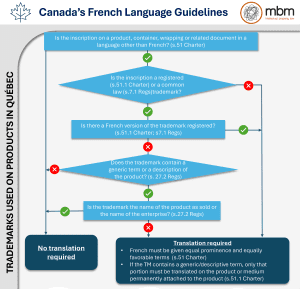
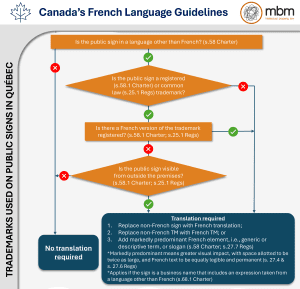
If you sell products or have public signage in the Province of Québec, then please consider what changes, if any, will be necessary to the product inscriptions/packaging and signage to ensure compliance with the amendments to the Charter of the French Language, c-11, which came into force on June 1, 2025.

To assist with your review, MBM has prepared the following flow charts:


MBM has developed creative solutions to minimize product inscriptions/packaging and signage changes and yet still be in compliance with the amendments to the Charter of the French Language, c-11, which came into force on June 1, 2025. The flow charts are provided only as a general guide based on known amendments to the Charter of the French Language, c-11. Future amendments or regulations may impact the information provided above.

If you would like to learn more or require any advice, please contact:

Scott Miller, Co-Managing Partner, Head of the Litigation Department
T: 613-801-1099
E:  smiller@mbm.com

Deborah Meltzer, Partner, Lawyer & Trademark Agent
T: 613-801-1077
E: dmeltzer@mbm.com


This article is general information only and is not to be taken as legal or professional advice. This article does not create a solicitor-client relationship between you and MBM Intellectual Property Law LLP. If you would like more information about intellectual property, please feel free to reach out to MBM for a free consultation.

Important CIPO Update – Amendments to Canadian Patent Rules

Canadian Intellectual Property Office (CIPO) just announced that the new amendments to the Canadian Patent Rules to ‘streamline examination’, including excess claim fees, will be coming into effect on October 3, 2022. The changes will include a $100/per claim fee for applications with more than 20 claims and a fee for continued examination after three office actions equal to the original examination fee. The amendments also add steps such as ‘notice of conditional allowance’.

As a result of these changes, we advise our clients to review their patent portfolios to determine which patents have over 20 claims and request examination for these patents before the October 3, 2022 date to avoid paying the access claim fees, as they would apply at the examination stage after this date.

We will follow up this announcement with more comprehensive coverage of the new changes to Canadian Patent Rules – stay tuned!


For more information please contact:

Claire Palmer, Ph.D., Senior Patent Agent
T: 613-801-0450
E: cpalmer@mbm.com

This article is general information only and is not to be taken as legal or professional advice. This article does not create a solicitor-client relationship between you and MBM Intellectual Property Law LLP. If you would like more information about intellectual property, please feel free to reach out to MBM for a free consultation.

Health Canada to Draft New Patented Medicine Prices Review Board Guidelines in the Wake of Pharmaceutical Victories

Canada’s Patented Medicine Prices Review Board (PMPRB) is a quasi-judicial body that has authority under the Patent Act to protect and inform Canadians “by ensuring that the prices of patented medicines sold in Canada are not excessive and by reporting on pharmaceutical trends”.[1]

Two recent decisions[2] from Canadian appellant courts surrounding the scope of the PMPRB’s authority under the Patent Act represent victories for the pharmaceutical industry, sending a strong signal that the PMPRB does not have the jurisdiction to consider consumer protection or general regulations of drug pricing in its determination of “excessive” pricing.

In response to these recent appellant decisions, the Canadian Minister of Health announced in April that there will be “a new and different set of guidelines” prepared for consultation in the coming months. Notably, these amendments will not include the proposed economic, regulatory factors for drug pricing nor the net price disclosure requirements held to be unconstitutional by the Quebec Court of Appeal.[3] The Minister of Health also stated that Health Canada will be implementing the “new basket of comparator countries” as an amendment to the Patented Medicines Regulations, which will come into force on July 1, 2022.[4] This amendment removes the US and Switzerland and adds Japan, Norway, Belgium, Australia, and the Netherlands as comparator countries.[5]

Importantly, while rights holders will need to begin reporting price information in accordance with the new comparator countries beginning on July 1, 2022, there will be a temporary period during which no guidelines will be in effect. During this period, the PMPRB will be holding expedited written consultation on what price tests should be applied, the details of which will be communicated once the new draft guidelines have been published in the Canadian Gazette. Once the new guidelines are finalized, rights holders will be provided with a reasonable period to become compliant.[6] Although the PMPRB is aiming to have these new draft guidelines published in a timely manner, no firm time frame has been established.

This response by the Canadian government should benefit pharmaceutical companies by ensuring that the PMPRB does not exceed its authority by considering consumer protection or general pricing regulations in its determination of “excessive” pricing. In the meantime, we anxiously await the release of the new PMPRB guidelines.


For more information please contact:

Claire Palmer, Ph.D., Senior Patent Agent
T: 613-801-0450
E: cpalmer@mbm.com


This article is general information only and is not to be taken as legal or professional advice. This article does not create a solicitor-client relationship between you and MBM Intellectual Property Law LLP. If you would like more information about intellectual property, please feel free to reach out to MBM for a free consultation.


[1] http://pmprb-cepmb.gc.ca/home

[2] Alexion Pharmaceuticals v. Canada (Attorney General) 2021 FCA 157
Merck Canada Inc. vs. Attorney General of Canada 2022 QCCA 240

[3] “Update – PMPRB Response to the April 14, 2022 statement from Minister of Health on the Coming-into-Force of the 2019 Regulations Amending the Patented Medicines Regulations” (April 22, 2022).

[4] Office of Honourable Jean-Yves Duclos, Minister of Health, “Statement from Minister of Health on the Coming-into-Force of the Regulations Amending the Patented Medicines Regulations” (April 14, 2022).

[5] “Regulations Amending the Patented Medicines Regulations (Additional Factors and Information Reporting Requirements): SOR/2019-298” Canada Gazette, Part II, Volume 153, Number 17.

[6] Office of Honourable Jean-Yves Duclos, Minister of Health, supra note 4.

Conference Posters and Materials: Beware! They Can Constitute Prior Art

In the academic world, it is common for researchers to attend and present their findings at conferences. Papers presented will typically end up as part of conference handouts or available online for future use. PowerPoint slides used in presentations are also sometimes published or distributed. Posters are often set up where attendees may view them. Conversations between researchers happen after presentations, and at numerous coffee breaks and networking events. In the publish or perish world of academia, conferences provide one of the best venues to present your ideas and research and meet with like-minded people.

Similarly, in the corporate world tradeshows are often used to show off products and demonstrate their features and capabilities to potential customers. Trade show booths often include demonstration systems, brochures, and marketing presentations that are only available for the two or three days of the show. Copies of brochures and presentations may be saved or may be destroyed afterwards.

Unfortunately, what is good for the sharing of information is often not good for the patenting of inventions that arise from the research and products presented at these conferences. The subject matter of a patent claim must not have been previously disclosed, and the invention must not be obvious to a person skilled in the art or science to which it pertains[1]. Conference presentations, presentation slides, and posters can all be prior art, whether they come from an inventor or someone else, and can prevent you from patenting your inventions.

Posters are an interesting case in that they may often be displayed for just a few hours, be viewed by passersby, and usually do not become part of the published conference proceedings. They are often untraceable or destroyed later. They often will not contain enough information to prevent an invention from being novel, but nevertheless may form part of the state of the art that must be considered when determining if an invention contains an inventive step.

In Biogen Canada Inc. v. Taro Pharmaceuticals Inc., 2020 FC 621, a poster was presented at a conference in Baltimore in 2002, 18 years previous. The poster was available to the court but had only been presented for a short time at the conference, and in the intervening years could not have been found even with a reasonably diligent search. Nevertheless, expert testimony established that the poster was indeed genuine and therefore its contents formed part of the state of the art in 2002 for determining obviousness of the patent claims in question. The poster, together with information found in other sources of prior art, were enough to find the patent claims in question obvious and invalid. This case is interesting since a poster, only presented for a short time at the conference and thereafter not being available, was used to establish the state of the prior art 18 years ago.

In Mediatube Corp. v. Bell Canada, 2017 FC 6 the plaintiff alleged that the defendant’s Fibe TV service could be modified to infringe its patents. Bell argued that all limitations of the relevant patent claims had been disclosed in a number of sources, including brochures and prototype systems that had been presented at the SuperComm tradeshow in June 1998, 19 years previous. Brochures were available to the court. Mediatube argued that the brochure was only disclosed at the tradeshow and could not be considered to have been available to the public as it could not later be found in a reasonably diligent search by a skilled person. With the help of expert testimony, the court decided that the brochures and presentations of the systems, despite only being available for a short time, were part of the state of the art at the time and could be considered when determining the validity of Mediatube’s patent claims.

On the other hand, in Valence Technology, Inc. v. Phostech Lithium Inc., 2011 FC 174, the defendant was challenging the validity of plaintiff’s patents. Phostech asserted that conference publications, presentations, and posters presented twelve years previous were prior art to at least some of the patent claims. The presenter had also had discussions while at the conference. The poster had since been destroyed and could not be presented to the court. When defining the common general knowledge at the key date the judge decided to exclude the presentations, posters, and any discussions that may have happened. Though not stated, this may have been because the poster had been destroyed and that there were no experts to testify to its contents or importance.

It is difficult to determine in advance if a poster will later be found to form part of the state of the art when considering patent validity. For prior art, such as a poster, that may only be presented for a few hours at a scientific or industry conference, it is uncertain whether it can be considered part of the body of prior art of which a person skilled in the art could be said to possess, especially since it may not be found later even through a reasonably diligent search. Like any disclosure, the best practice is to:

1. Review all public disclosures, even those that are short-lived and will be unavailable later.

2. Be careful what kind of information you put on a poster. Try to use more general information on all conference materials if possible.

3. If you must disclose detailed information, restrict any disclosures to individuals or groups in a non-public space under NDA.

4. File a provisional or utility patent application before the event.

5. Review and document what others present. Smartphones make it easy.

Better to be safe than sorry!

If you are considering filing a patent and are worried about your conference/event disclosure, please feel free to contact MBM for a free consultation.

T: 613-567-0762
E: patents@mbm.com


This article is general information only and is not to be taken as legal or professional advice. This article does not create a solicitor-client relationship between you and MBM Intellectual Property Law LLP. If you would like more information about intellectual property, please feel free to reach out to MBM for a free consultation.

[1] Canadian Patent Act 28.2 and 28.3. https://laws-lois.justice.gc.ca/eng/acts/P-4/page-10.html#docCont

Late Report of Patent Grant leads to Irretrievable Loss of Drug Patent Register Listing Rights

Merck Canada Inc. v Canada (Health), 2021 FC 345

The grant of a patent containing a claim that relates to a medicine or use of the medicine approved by Health Canada triggers a 30-day deadline from the date of payment of the final fee to list the patent on the Patent Register maintained by the Therapeutic Products Directorate. A careful review of the timing of the grant after payment of the Final Fee (i.e., Issue Fee) in this case and the Canadian Intellectual Property Office’s service standards offers valuable lessons.

In this decision, the Federal Court (the “FC”) dismissed an application for judicial review brought by Merck Canada Inc. (“Merck”) over the refusal by the Minister of Health (the “Minister”) to add Canadian Patent No. 2,830,806 (the “‘806 Patent”) to the Patent Register pursuant to section 4(6) of the Patented Medicines (Notice of Compliance) Regulations (the “PM(NOC) Regulations”).

BACKGROUND

Merck markets KEYTRUDA®, a biologic drug for the treatment of certain advanced-stage cancers. The ‘806 Patent was issued on May 12, 2020, and contains claims that are directed to a formulation of the drug KEYTRUDA®.

The issuance of the ‘806 Patent was not reported by the Canadian patent agent retained by Merck’s American parent company (“Merck USA”) until June 15, 2020, more than a month after the patent had issued. Merck USA had however independently learned of the issuance on June 12, 2020 and immediately instructed Merck to take the necessary next steps. Patent lists were submitted the same day, but after the close of business, and were therefore deemed to have been filed on Monday, June 15, 2020.

On June 19, 2020, the Minister informed Merck of the preliminary determination that the patent lists relating to the ‘806 Patent were ineligible for being submitted outside of the 30-day window stipulated in section 4(6) of the PM(NOC) Regulations. Merck replied with written representations and affidavit evidence.

The Minister later confirmed on November 6, 2020 that the patent lists relating to the ‘806 Patent were ineligible for inclusion on the Patent Register holding, among other elements, that the Time Limits and Other Periods Act (COVID-19) (the “Time Limits Act”) does not extend the deadline within which first persons may submit patent lists in accordance with s 4(6) of the PM(NOC) Regulations; and that the 30-day deadline in section 4(6) of the PM(NOC) Regulations is not discretionary.

ANALYSIS

Merck argued that the Minister’s refusal would deprive the patent holder of substantial protections available under the PM(NOC) Regulations. Additionally, Merck said it would suffer prejudice because a subsequent entrant would be able to file a drug submission after the expiry of the six-year “no file” period for KEYTRUDA®, on May 19, 2021.

The issues, in this case, were a) was the Minister’s determination reasonable that the Time Limits Act cannot be applied here and as a result cannot suspend the 30-day time period specified in section 4(6) of the PM(NOC) Regulations? And b) was the Minister’s determination reasonable that she had no discretion to extend the 30-day time period specified in section 4(6) of the PM(NOC) Regulations?

The FC determined that the Minister’s decision would be subject to review against the standard of reasonableness, meaning the FC would only intervene if “there are sufficiently serious shortcomings in the decision such that it cannot be said to exhibit the requisite degree of justification, intelligibility and transparency.”

With regard to the reasonableness of the Minister’s determination, that the Time Limits Act did not cause suspending of the 30-day time period specified in section 4(6) of the PM(NOC) Regulations, the FC found that the Time Limits Act applied in only three circumstances: limitation or prescription periods for commencing a proceeding before a court; time limits for doing something in a proceeding before a court; and time limits where a party makes an application for leave of a court, either to commence a court proceeding or to do something in relation to a court proceeding. Merck asserted that section 4(6) of the PM(NOC) Regulations functions as a “gateway” to the summary litigation provisions that begin at section 6(1), and therefore Merck argued that the 30-day period specified in section 4(6) of the PM(NOC) Regulations is a “limitation period within a limitation period.” The FC concluded that the listing of a patent on the Patent Register pursuant to section 4(6) of the PM(NOC) Regulations is too remote from the commencement of a court proceeding under section 6(1) to constitute a “limitation period within a limitation period” for the purpose of section 6(1) of the Time Limits Act.

With regard to the Minister’s determination that she had no discretion to extend the 30-day time period specified in section 4(6) of the PM(NOC) Regulations being reasonable, Merck relied on a previous FC decision to argue that the Minister may add a “late” patent list to the Patent Register. The FC was not convinced of this argument though, maintaining that it is well established that the timelines prescribed by the PM(NOC) Regulations are exact. The FC further added that the 2017 amendments to the PM(NOC) Regulations also did not confer any new discretionary powers to the Minister.

The FC concluded that the Minister’s decision was justified, intelligible and transparent, and therefore reasonable. No costs were awarded by agreement of the parties.

COMMENTARY

A patent will only issue in Canada following payment of the Final Fee. The Client Service Standards at CIPO for grant of a patent after payment of the Final Fee is stated as being within 12 weeks (Client Service Standards – Canadian Intellectual Property Office).

The Final Fee for the ‘806 application was paid on March 20, 2020. The ‘806 patent granted 53 days later (about 7½ weeks) well before the 12 weeks service standard. A brief review of recently issued patents in Canada indicates that the quick grant of the ‘806 patent was not an anomaly and that patents are regularly granting within 6 to 8 weeks of payment of the Final Fee.

A key takeaway from this case is that once the Final Fee is paid for applications that are eligible for listing on the Patent Register, the CIPO database should be monitored closely for grant of the patent. To help with that, CIPO now also lists “Forecast Issue Date” on the Administrative Status page for each patent application and further sends a notification by email that the patent has granted. Please note that this is also applicable when filing a divisional application after payment of the Final Fee.

For more information please contact:

Claire Palmer, Ph.D., Senior Patent Agent
T: 613-801-0450
E: cpalmer@mbm.com

This article is general information only and is not to be taken as legal or professional advice. This article does not create a solicitor-client relationship between you and MBM Intellectual Property Law LLP. If you would like more information about intellectual property, please feel free to reach out to MBM for a free consultation.

Effective Consent Made Easier Under the NOC Regulations

Case introduction:

The Patented Medicines (Notice of Compliance) Regulations (“NOC Regulations”) permit the Minister of Health (“Minister”) to issue a notice of compliance (“NOC”) to a generic company where a patentee’s effective consent is obtained. Effective consent under the NOC Regulations requires the patentee’s consent for the making, constructing, using or selling of a drug in Canada (“Activities”). This was at issue in Fresenius Kabi Canada Ltd. v. Canada (Health), 2020 FC 1013 in which the Federal Court of Canada (“Court”) determined that effective consent under the NOC Regulations requires the patentee’s consent for only one of the Activities and not all Activities.

Case background:

Fresenius Kabi Canada Ltd. (“the Applicant”) brought an application for judicial review of the Minister’s refusal to issue a NOC. The Applicant had sought an NOC for its drug adalimumab, IDACIO, which is a biosimilar of the drug, HUMIRA, owned by AbbVie Biotechnology Ltd. (“AbbVie”). AbbVie also owns a number of patents (“Patents”) in respect of HUMIRA. In seeking an NOC, the Applicant had relied on AbbVie’s consent to comply with the NOC Regulations. AbbVie had provided immediate consent to the making and constructing of IDACIO, and a delayed consent, until after February 15, 2021, to the using and selling of IDACIO. The Minister refused to issue a NOC because AbbVie’s consent was only effective after February 15, 2021, when consent to all Activities had been provided.

The Court decision:

The Court found the Minister’s refusal unreasonable partly because the Minister erred in interpreting the word “or” as conjunctive “and” in the NOC Regulations, which recites “consent to the making, constructing, using or selling of the drug in Canada.” The Court reasoned that “the word ‘or’ is presumed to be disjunctive, but inclusive, such that, as in this case, a patent owner could consent to each or a combination of the activities listed – making, constructing, using or selling – to meet the [consent] requirements” of the NOC Regulations. The Court found AbbVie’s consent as unequivocal to all Activities, despite the temporal nature of the consent. The Court overturned the Minister’s decision and ordered the Minister to issue the NOC.

The Court based its reading of the word “or” on the NOC Regulations’ dual purpose, “to balance effective patent enforcement over new and innovative drugs with the timely market entry of their lower-priced generic competitors.” The Court noted that an NOC is essential for the timely launch of a biosimilar product, which is critical for biosimilars to remain competitive and establish their market position.

Key takeaway:

The Court’s interpretation of the word “or”, as disjunctive, but inclusive, clarifies that requirements of consent, under the NOC Regulations, are met so long as the patent owner consents to at least one of the Activities.

Please feel free to reach out to MBM with regards to any Intellectual Property matters in Canada.

For more information please contact:

Jamal Hakimi, Intellectual Property Lawyer
T: 613-801-0509
E: jhakimi@mbm.com


This article is general information only and is not to be taken as legal or professional advice. This article does not create a solicitor-client relationship between you and MBM Intellectual Property Law LLP. If you would like more information about intellectual property, please feel free to reach out to MBM for a free consultation.

The Impact of CIPO’s New Guidance on the Prosecution of Patent Applications Directed to Diagnostic Methods

The Federal Court in Choueifaty v. Canada (Attorney General), 2020 FC 837 decision found that CIPO’s problem and solution framed “purposive construction” was inconsistent with the principles set forth by the Supreme Court of Canada (for more background information, please see our previous article). The CIPO has now issued examination guidance in light of this decision. The updated guidance will be applied effective immediately to applications currently in prosecution as well as those presently before the Patent Appeal Board.

We believe that the impact of this change in CIPO’s practice with respect to claim construction will positively impact the prosecution of many diagnostic method patent applications. In particular, a number of claims which were found to be directed to non-statutory subject matter when incorrectly construed using the problem solution approach may now be found to be directed to statutory subject matter when construed correctly using purposive construction.

To illustrate this impact, the following claim (from the examples included in CIPO’s notice) has been construed using CIPO’s incorrect problem solution approach and the correct purposive construction approach.

Claim:

1. A method of diagnosing whether a human subject is at risk for developing cancer, comprising:

a. measuring the level of X in a biological sample from the subject; and

b. comparing said level to the level of a non-cancerous reference sample, wherein an increase in the level of X relative to said reference indicates the subject is at risk for cancer.

Under CIPO’s Incorrect Problem-Solution Claim Construction:

The typical problem CIPO would have identified for this type of claim under the problem-solution approach is a data analysis problem (i.e. relating the level of X to cancer risk). The solution to the problem CIPO would likely have identified would have been a correlation between cancer risk and the level of X and accordingly the steps related to measuring the level of X and comparing the level would have been regarded as non-essential. As such, the only element CIPO would have identified as essential would be the correlation between cancer risk. Such a correlation step is a disembodied idea and therefore the CIPO would have found that the claim is directed to non-statutory subject matter.

Under Purposive Construction:

There is no language in the claim indicating that any of the steps are optional. Accordingly, all the steps (including the steps related to measuring X and comparing the level of X) are essential.

As the essential elements are not limited to a disembodied idea, CIPO would find that the claim is directed to statutory subject matter.

Given this change in CIPO’s practice, we recommend reassessing any cases directed to diagnostic methods that were impacted by CIPO’s incorrect problem-solution claim construction methodology.

Please feel free to reach out to MBM if you need help regarding reassessing any cases directed to diagnostic methods.

For more information please contact:

Kay Palmer, Ph.D., Senior Patent Agent
T: 613-801-0452
E: kpalmer@mbm.com

Claire Palmer, Ph.D., Senior Patent Agent
T: 613-801-0450
E: cpalmer@mbm.com


This article is general information only and is not to be taken as legal or professional advice. This article does not create a solicitor-client relationship between you and MBM Intellectual Property Law LLP. If you would like more information about intellectual property, please feel free to reach out to MBM for a free consultation.
 

New Federal Court Decision Provides for Greater Protection of Combination Drugs Under CETA

In 2017, the Canada-European Union Comprehensive Economic and Trade Agreement (CETA) came into force. CETA covers virtually all sectors and aspects of trade and aims to increase bilateral trade and investment between Canada and the EU. In order to comply with this agreement, Canada enacted the CETA Implementation Act (CIA) which provided for, among other things, the introduction of the Certificate of Supplementary Protection (CSP) to the Patent Act. CSPs offer up to two years of additional protection to patentees for the medicinal ingredient or the combination of medicinal ingredients in a drug and is meant to compensate for time spent researching and obtaining regulatory approvals. In order to receive a CSP, the drug must be approved by Health Canada via a Notice of Compliance (NOC).

On July 10, 2020, the Federal Court issued a decision in a judicial review on the Minister of Health’s (the “Minister”) refusal to issue a CSP to ViiV Healthcare ULC (“ViiV”) in respect of Canadian Patent No. 2,606,282 (the “282 patent”) and the drug JULUCA®. JULUCA® is a combination drug containing medicinal ingredients dolutegravir and rilpivirine. The 282 patent is listed on the Patent register with respect to JULUCA®. The 282 patent, has claims directed only to dolutegravir, but does not have claims directed at the combination of dolutegravir and rilpivirine.

At issue in this judicial review, was whether the Minister had reasonably interpreted the Patent Act and the CSP Regulations (CSPR) in a manner that was consistent with CETA. The Minister was of the position that a CSP could not be granted because the 282 Patent does not pertain to the combination of the medicinal ingredients contained in JULUCA®. In taking this position, the Minister relied primarily on the Regulatory Impact Analysis Statement (RIAS) for the CSPR and the CSP’s Guidance Document. ViiV took the position that CETA’s intellectual property provisions were intended to provide protection for single medicinal ingredients or combinations of medicinal ingredients in new drug products. In addition, ViiV contended that the Minister’s interpretation would incentivize drug manufacturer’s to continue to make separate products instead of innovating fixed-dose combination therapies. The Court held that the Minister had unreasonably considered ViiV’s submission since the CIA required that the CSP legislation be interpreted in a manner that was consistent with CETA and that the sole reliance of the Minister on the CSPR RIAS and associated Guidance Document was not adequate, as neither CSPR RIAS nor the Guidance document has legislative force. As such, the Court granted the judicial review and remitted the matter to the Minister for redetermination.

In conclusion, this decision, if not appealed by the Minister would expand the scope of combination drugs eligible for CSP protection. In addition, this decision exemplifies the importance of harmonious interpretation of Canada’s international obligations and the statutory language with respect to IP protection in Canada.

For more information, please contact:

Poonam Tauh, Partner, Patent Agent
T: 403-800-9018
E: ptauh@mbm.com

This article is general information only and is not to be taken as legal or professional advice. This article does not create a solicitor-client relationship between you and MBM Intellectual Property Law LLP. If you would like more information about intellectual property, please feel free to reach out to MBM for a free consultation.
Importance of Determining Inventorship Prior to Patent Issuance

Determining inventorship, prior to patent issuance, can save an applicant the costly procedural and evidentiary burden required for correcting the named inventors post patent issuance. Since Canadian patent law requires that each patent application list the sole inventor(s) of the claimed invention, divisional applications derived from an application having two or more inventors must list only the inventors that contributed to the claimed invention.

Although a patent may still be issued for an application not listing the sole inventor(s) of the claimed invention, the patentee may be required to correct the records of the Patent Office to reflect the sole inventor(s). However, post patent issuance, to correct the records of the Patent Office, the patentee must bring an application to the Federal Court (“Court”). In doing so, the patentee must follow the evidentiary and procedural requirements for removing a named inventor and/or adding an inventor to the named inventors of the issued patent. This was the case in Inguran LLC dba STgenetics v Commissioner of Patents, 2020 FC 338, for which the patentee, STgenetics, brought an application to the Court for an order to remove six of the twelve named inventors from the records of the Patent Office relating to four issued patents.

To obtain the order for removing named inventors, STgenetics had to meet the test outlined in Imperial Oil Resources Ltd v Canada (Attorney General), 2015 FC 1218. The test asks two questions:

 1. Does it appear that one or more of the named inventors have no part in the invention? and

2. Has an affidavit been provided to satisfy the Court that the remaining inventors are the sole inventors?

In order to meet the test, STgenetics provided affidavits from both inventors determined to have contributed to the issued patents and from non-inventors incorrectly named as inventors. The determined inventors deposed that they contributed to the issued patents, and the non-inventors deposed that they did not contribute to the issued patents.

Based on STgenetics’ evidence, the Court determined that STgenetics met the procedural and evidentiary burden required for removing the names of the non-inventors. Accordingly, the Court ordered the Commissioner of Patents (“Commissioner”) to vary the records of the Patent Office with respect to the inventorship of the issued patents.

Although STgenetics’ application to the Court was successful, the application and the evidentiary burden to satisfy the Court of the relevant jurisprudential tests and procedural requirements could have been avoided had the inventorship been determined prior to the issuance of the patents. STgenetics, could have simply, prior to receiving the notice of allowance, requested the Commissioner to remove the names of the non-inventors and submitting the affidavits. Had STgenetics done so, it could have saved the time and money spent in pursuing the Court application.


For more information please contact:

Jamal Hakimi, Patent Lawyer
T: 613-801-0509
E: jhakimi@mbm.com

This article is general information only and is not to be taken as legal or professional advice. This article does not create a solicitor-client relationship between you and MBM Intellectual Property Law LLP. If you would like more information about intellectual property, please feel free to reach out to MBM for a free consultation.

Absence of a Canadian patent leaves the PMPRB powerless to control the price of Cystadrops

While the Patented Medicines Prices Review Board (“the PMPRB”) polices the prices of patented medicines in Canada, a recent article in The Globe and Mail suggested that a loophole may exist for drug manufacturers that have chosen not to acquire Canadian patent protection.

Cystadrops, a cysteamine hydrochloride-based eye drops formulation is produced by Recordati Rare Diseases Inc. (“Recordati”), and is used to treat a rare disease known as cystinosis. Cystinosis is characterized by the abnormal accumulation of the amino acid cystine in various organs of the body, including crystal build up in the eyes. While about one hundred Canadians suffer from cystinosis, the cost for a year’s supply of Cystadrops is approximately $111,000 per individual.

This price is largely due to the fact that Cystadrops does not fall within the jurisdiction of the Canadian federal regulatory body for medicines pricing. As Recordati chose not to obtain a Canadian patent for its formulation, any price regulation for Cystadrops by the PMPRB would be ultra vires. Compounding pharmacies in Canada largely stopped making cheaper versions of the drug when Recordati’s version was given the green light by Health Canada.

Another interesting aspect to note is that typically data privacy regimes provide innovative drugs with a data protection period of eight or eight and a half years, during the first 6 of which a (typically generic) manufacturer seeking a Notice of Compliance (“NOC”) will be prevented from filing its drug submission.

A search of the Register of Innovative Drugs has revealed that while there is no active data protection over Cystadrops, a related formulation of cysteamine bitartrate is protected and is associated with another company. Whether any patent or NOC links exist between the two formulations, or another third party for that matter, remains unclear. Furthermore, perhaps the very small market of just one hundred people acts a natural barrier to entry for generics or compounding pharmacies to invest in preparing the formulation.

With drug pricing regulations already being a contentious issue in Canada, it will certainly be of interest to see how this particular situation will develop, or if more information will be brought to light. In any case, as a result of the price of Cystadrops, Ontario became the first province to fund the drug, with other provinces expected to follow suit.

T: 613-567-0762
E: patents@mbm.com

Authors: Osman Ismaili, Patent Associate


This article is general information only and is not to be taken as legal or professional advice. This article does not create a solicitor-client relationship between you and MBM Intellectual Property Law LLP. If you would like more information about intellectual property, please feel free to reach out to MBM for a free consultation.
Top Top