Government IP Funding Programs Across Canada

Securing intellectual property (IP) rights is a critical step for businesses, particularly for start-ups and small or medium-sized enterprises (SMEs), who want to gain a competitive advantage in the marketplace. To assist in funding IP-related costs, various government funding programs have been developed across Canada to help companies secure IP rights.

Below are some common funding programs available across Canada.

Elevate IP:

ElevateIP is a federal program delivered Canada-wide through selected business accelerators and incubators (BAIs) in collaboration with regional partners to help start-ups develop and implement IP strategies, in addition to offering IP education services.

While eligibility requirements and funding amounts vary depending on the BAI administering the program, start-ups may be eligible for up to $100,000 to develop and implement an IP strategy. Most BAIs require, at a minimum, that the start-up have less than 500 employees and be headquartered in the geographic region of the BAI administering the program. The program funding is divided into 3 tiers:

  1. IP Education & Awareness
  2. IP Strategy Development
  3. IP Strategy Implementation

The selected BAIs in different provinces are listed below:

To learn more about the Elevate IP program, please click here.

IP Assist (IRAP):

IP Assist, administered by The National Research Council of Canada Industrial Research Assistance Program (NRC IRAP), is a tiered national funding program designed to support SMEs’ IP efforts. Under the IP Assist Program, SMEs can receive support and funding across three different levels:

  • L1 – IP Awareness
  • L2 – IP Strategy
  • L3 – IP Action

The funding available for IP Strategy and IP Action ranges from $10,000 to $25,000 for each, with an additional $1,000 for IP awareness. To learn more about the IP Assist program, please click here.

Intellectual Property Ontario (IPON):

IPON is a provincial-run program that provides support to Ontario-based SMEs operating in one of IPON’s served sectors – MedTech, life sciences, artificial intelligence, vehicle technology, and mining and advanced manufacturing – to promote innovation and growth in these highly desired sectors in Ontario. Once the SME is enrolled as an IPON client and is part of IPON’s IP Bootcamp or Partner Program, it may be eligible for up to $35,000 in initial funding for IP protection and commercialization services and have potential access to future IP funding of up to $100,000. It’s important to note that the SME has to cover 20% of IP service costs directly, and IPON covers 80%. To learn more about the IPON program, please click here.

Innovation Access Collective (IAC):

IAC is a membership-based not-for-profit organization funded by the Government of Canada to assist Canadian SMEs in the data-driven CleanTech sector with IP-related needs. Full members may be eligible for grant funding ranging from $5,000 to $20,000, while associate members may be eligible for grant funding ranging from $5,000 to $10,000. In addition, IAC also has a Grant for Women in IP created in response to the demonstrated inequitable gender balance in the IP ecosystem. To learn more about the IAC program, please click here.

CanExport Innovation:

CanExport Innovation provides funding for intellectual property protection in international markets and other related services for Canadian SMEs looking to expand into international markets to develop R&D collaborations through partnerships in foreign markets. Businesses may be eligible for funding of up to $75,000 to assist with research and development (R&D) for a single technology. To learn more about the CanExport Innovation program, please click here.

Eligibility requirements and application process:

Please note the information presented in this article represents only a general outline and the above programs are subject to specific eligibility requirements that are listed on their respective websites that are linked above. For more information, please reach out to an MBM professional who can assist you in determining the best funding program for your business and assist you through the application process.

While some of the above programs accept applicants on a “rolling basis”, other programs require applicants to apply to open calls subject to strict deadlines. We strongly encourage businesses looking to apply to consult the program websites linked in this article for further information regarding eligibility criteria, program application process and deadlines.

MBM is an approved service provider for ElevateIP, IP Assist, and IPON.

If you would like to learn more or require any advice, please contact:

Kay Palmer, Ph.D., Senior Patent Agent
T: 613-801-0452
E:  kpalmer@mbm.com
This article is general information only and is not to be taken as legal or professional advice. This article does not create a solicitor-client relationship between you and MBM Intellectual Property Law LLP. If you would like more information about intellectual property, please feel free to reach out to MBM for a free consultation.

CIPO Fees to Increase by 25% in 2024 and Expansion of the Definition of “Small Entity”

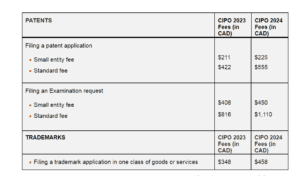
The Canadian Intellectual Property Office (“CIPO”) has announced that effective January 1, 2024, most official fees will be increasing by 25%. On the patent side, the increase in the fees will be applicable to standard entity size. At the same time, the definition of “small entity” in the Patent Rules will be broadened from the current 50 employees to fewer than 100 employees, which would mean that more companies can fall into the small entity category and thus utilize the lower official fees. Canada remains an important jurisdiction in North America for IP filings and is further reinforced by rapid population growth, surpassing the 40 million mark in 2023. The above changes are detailed below with some recommendations for saving on official fees.

Significant CIPO Fee Increase

Effective January 1, 2024, a one-time 25% fee increase will be implemented, impacting most patent, industrial design, trademark and copyright fees. With respect to patent matters, this increase will not apply to businesses qualifying as a “small entity” under the Patent Rules. Thus, small entity patent applicants will only experience CIPO’s regular annual fee increase in 2024.

Below are a few examples of changes in CIPO’s fees (rounded up):

A complete listing of fee increases relating to patents, industrial designs, trademarks, copyrights, and other fees can be found on CIPO’s website here.

Expansion of the definition of “Small Entity” under the Patent Rules

Another important change is the broadening of the definition of “small entity” in the Patent Rules. This change is important because entities that meet the definition of small entity and who submit a small entity declaration are entitled to a 50% reduction of some CIPO patent-related fees.

Currently, a “small entity” is defined as a university or an entity that employs 50 or fewer employees at the time the patent application was filed or at the national phrase entry date for an international PCT application but does not include:

(a) an entity that is controlled directly or indirectly by an entity other than a university, that has more than 50 employees, or

(b) an entity that has transferred or licensed, or has an obligation other than a contingent obligation to transfer or license, any right or interest in a claimed invention to an entity other than a university that has more than 50 employees

The definition of “small entity” will be amended effective January 1, 2024, to increase the maximum number of employees from 50 employees to fewer than 100 employees. Thus, more companies will be able to qualify for the small entity category and, as a result, utilize the lower small entity fees. Please note that small entity status is determined at the time of filing (or at the national phrase entry date) and is only determined once.

This amendment does not entitle newly qualifying small entities to a partial refund of fees paid before January 1, 2024. The amendment is, however, allowing applicants who had more than 50 employees but less than 100 employees at the time of filing (or at the national phrase entry date) to start paying future fees at the small entity rate after January 1, 2024, provided all other small entity conditions were met when the patent was filed, and a small entity declaration is submitted.

Recommendations

1. As a result of these changes, individuals and businesses are encouraged to review their IP portfolios with their IP professional for possible new filings, examination requests and renewal/maintenance fees that can be done before January 1, 2024, to take advantage of the lower 2023 rates before the 25% increase takes effect.

2. Additionally, applicants should also review with their IP professional whether they will qualify as of January 1, 2024, for the expanded small entity status.

For more information, please contact:
Randy Marusyk, Co-Managing Partner
T: 613-801-1088
E: rmarusyk@mbm.com


This article is general information only and is not to be taken as legal or professional advice. This article does not create a solicitor-client relationship between you and MBM Intellectual Property Law LLP. If you would like more information about intellectual property, please feel free to reach out to MBM for a free consultation.


Does Copyright Extend to “facts”? The Federal Court Sets the Story Straight on the Extent of Copyright Protection in Non-fiction Work

INTRODUCTION

In the recent 2021 decision of Winkler v. Hendley, 2021 FC 498 [Winkler], the Federal Court (the “Court”) addressed an unusual issue of copyright protection in a nonfictional work containing descriptions of events with questionable historical accuracy. In its decision, the Court reiterated that copyright protection does not extend to facts. Moreover, when a work is presented as nonfiction, the facts are not subject to copyright protection. This case serves to reinforce the scope of copyright protection and sets an important precedent in Canada for copyright in nonfictional works.

CASE BACKGROUND AND OVERVIEW OF THE DISPUTE

In Winkler, the plaintiffs, John Winkler and the estate of the late author Thomas Kelley (“Mr. Kelley”) sued author, Nate Hendley (“Mr. Hendley”), and his publisher, James Lorimer & Company Ltd., the defendants, for copyright infringement. In 1954, Mr. Kelley published a book called The Black Donnellys, which was published and sold as a nonfictional account of a notorious family from Lucan, Ontario. In 2004, Mr. Hendley wrote and published a book called The Black Donnellys: The Outrageous Tale of Canada’s Deadliest Feud (the “Outrageous Tale”), which cited The Black Donnellys as authority for many of the historical events detailed in the book. Despite The Black Donnellys being published as nonfiction, the plaintiffs argued that some of the events described in the book were actually fictional, or contained embellishments made by the author. It was on the basis of these alleged embellishments and “fictional accounts” that the plaintiffs based their claim of copyright infringement against the defendants under sections 3[1] and 27[2] of the Copyright Act (the “Act”).

ANALYSIS AND DECISION

In its analysis, the Court began by clarifying that in Canada, copyright subsists “in every original literary work”, regardless of “whether that work is one of fiction or nonfiction”[3]. The Court further reiterated the longstanding principle that there is no copyright protection in facts or ideas, but rather, copyright protects the original expression of those ideas. What is critical for copyright infringement is whether there was a substantial taking of the work in issue, defined as the “part of the work that represents a substantial portion of the authors’ skill and judgment”[4]. Importantly, the historical accuracy of the presented facts in a work is not contemplated by the Act. Therefore, the factual aspects of The Black Donnellys were excluded from the Court’s comparison of passages from The Black Donnellys and the Outrageous Tale in its determination of whether there was copying of a “substantial part” of the originality of The Black Donnellys.

After the facts were excluded, the Court concluded that any similarities between the works were so minimal that they did not amount to a substantial taking. Therefore, the Court held that there was no copyright infringement. Moreover, the Court stressed that an author cannot publish a work as nonfiction and later claim that the facts were actually fiction for the purpose of pursuing a copyright case. There are clear public policy reasons behind this principle; the public should be able to rely upon published facts without the concern that the author will later turn around and sue for copyright infringement at a whim. The Court did leave open the possibility that future cases may arise in which asserted “facts” are so implausible that the work must be interpreted as a fiction; however, this scenario was not applicable in this case.

IMPORTANCE OF COURT DECISION AND KEY TAKEAWAYS

  • Winkler is the first Canadian decision addressing a nonfiction work that was later claimed to be fiction.
  • The law is similar in other countries; for example, in the United States, the doctrine of copyright estoppel (also known as the “asserted truths” doctrine) protects against copyright holders of a nonfiction work who subsequently seek to claim that the work is fiction as grounds for copyright infringement.
  • The Court further affirmed the longstanding principle that there is no copyright protection in facts or ideas but rather the expression of those ideas. Importantly, as a general rule, the accuracy of such facts or ideas is not contemplated for the purposes of copyright protection.

CONCLUSIONS

The decision in Winkler is an important consideration for authors who intend to publish and market a book, and highlights the need to look to the future regarding the scope of copyright protection in a published work. Of particular importance is the need to be clear about what is being presented as fact and what is embellished in a nonfictional account. Therefore, prospective authors should also consider consulting with a lawyer experienced in copyright law to discuss how they can best protect their rights in a given literary work.


For expert assistance with any issues pertaining to copyright in a work, please reach out to MBM for a free consultation:

Scott Miller, Co-Managing Partner, Head of the Litigation Department
T: 613-801-1099
E: smiller@mbm.com

This article is general information only and is not to be taken as legal or professional advice. This article does not create a solicitor-client relationship between you and MBM Intellectual Property Law LLP. If you would like more information about intellectual property, please feel free to reach out to MBM for a free consultation.

[1] Copyright Act, R.S.C., 1985, c. C-42, s 3(1).Copyright in works3 (1) For the purposes of this Act, copyright, in relation to a work, means the sole right to produce or reproduce the work or any substantial part thereof in any material form whatever.
[2] Ibid, s 27(1).Infringement generally27 (1) It is an infringement of copyright for any person to do, without the consent of the owner of copyright, anything that by this Act only the owner of the copyright has the right to do.
[3] Winkler at paras 53-54 citing CCH Canada Ltd v Law Society of Upper Canada, 2004 SCC 13 at paras 8, 14.
[4] Cinar Corporation v Robinson, 2013 SCC 73 at para 26.

Copyrights in Canada – Process, Timeline, Costs, and the Upcoming Proposed Changes to the Copyright Act

Most people are familiar with patents and trademarks as the most common forms of intellectual property, however, copyrights and their importance as part of your overall portfolio of intellectual property assets are sometimes neglected. This article attempts to broadly cover the subject of copyrights in Canada in terms of process, timeline, costs, as well as the upcoming proposed changes to the Copyright Act.

What rights does a copyright holder have?

Copyright is defined by the Canadian Intellectual Property Office (CIPO) as an exclusive right to produce, reproduce, publish, or perform an original literary, artistic, dramatic, or musical work.

A common misconception is that copyright protects an idea. The truth is that copyright does not protect the idea itself but instead protects the expression of an idea. This expression needs to be “fixed” in a tangible medium (written or recorded) for you to be able to copyright it. For example, copyright gives you the right to control the expression of your original written or recorded speech. As a result, you can charge a fee for allowing another party to express themselves in the same way you expressed yourself in your copyrighted speech as well as your copyrighted literary, artistic, dramatic, and musical works.

How long do copyrights last?

Copyright in Canada currently exists for the author’s lifetime, the remainder of the calendar year in which the author dies, plus 50 years following that calendar year.

However, changes to these current time limits are coming. On February 11, 2021, the Canadian government announced that due to the Canada-United States-Mexico Agreement (CUSMA), Canada has agreed to extend, by the end of 2022, the protection period to a minimum of the author’s lifetime, the remainder of the calendar year in which the author died, plus 70 years following that calendar year.

Why register copyrights?

Copyright is automatic and protects an original work the moment the work is created. Therefore, copyright does not have to be registered for an author to have copyright rights.

However, registering a copyright for your work can be very beneficial because going through the official registration process with the Canadian Intellectual Property Office (CIPO) results in a registration certificate. This registration certificate is an official Canadian government document that is proof that you have rights to your work’s expression and provides a date stamp. This registration certificate can be persuasive evidence when suing someone who is infringing your rights.

How long does it take to register a copyright?

Copyright registration can generally be obtained within a few weeks.

How much does it cost to register a copyright?

Copyright registration is relatively inexpensive. The full process from drafting the copyright application, ensuring that the work is categorized correctly, filing it, reviewing the issued certificate of registration, and sending it to the author, is approximately $400, including MBM professional fees and the required government fees.

What are the steps to register a copyright?

The first step is to draft and file a copyright application.

A crucial piece of information required at this step is the date and place of your work’s publication. It is critical to make sure that CIPO correctly records the date and place of publication if in the future you decide to litigate against an infringer and the infringer argues that their work predates your work.

The next step in the process is an examination of the application by CIPO. If the CIPO examiner determines that the application requires changes, amendments to the application will need to be filed to prevent rejection. Once all the objections are satisfied, the application will register, and the registration certificate will be issued.

What are the proposed amendments to the Canadian Copyright Act?

Two Private Member’s Bills C-272 and S-225, may result in changes to the Copyright Act.

Private Member’s Bill, C-272 was introduced on February 22, 2021, to add section 41.121 to the Copyright Act to modify the treatment of technological protection measures (TPMs). TMPs reduce copyright infringement by controlling the use of a work. The Copyright Act provides stiff penalties including, imprisonment and/or fines up to $1,000,000 for circumventing TMPs. The proposed amendment can allow a person to circumvent “a technological protection measure that controls access to a computer program if the person does so for the sole purpose of diagnosing, maintaining or repairing a product in which the computer program is embedded”. As a result, Bill C-272 will add an additional circumvention exception to the current circumvention exceptions allowed by the Copyright Act. The existing circumvention exceptions include exemptions for law enforcement and national security, reverse engineering for software compatibility, encryption research, verification if a TPM permits the collection or communication of personal information, security testing of computer systems, and accessibility for disabled persons.

Private members bill S-225 was introduced on February 17, 2021, to add a section to the Copyright Act to allow remuneration for journalistic works. This bill was introduced because news stories are easily shared using social media without paying a royalty to the copyright holder. As a result, news publisher’s advertising revenue has decreased significantly while at the same time, social media platforms that facilitate this sharing have significantly increased their advertising revenue. The amendment proposes to add, “[i]f a journalistic work … is reproduced or published on a digital platform that is owned or controlled by a designated digital platform provider, the Canadian journalism organization that owns the copyright in that journalistic work is entitled to remuneration”.

This article broadly covered the process of copyrights as well as some of the upcoming suggested changes to the Copyright Act. If you have created an original literary, artistic, dramatic, or musical work and you have further questions and would like to understand your rights and file one or more copyrights, please feel free to contact MBM for a free consultation.

For more information please contact:

Daniel Lanfranconi, Intellectual Property Lawyer
T: 613-801-1056
E: dlanfranconi@mbm.com


This article is general information only and is not to be taken as legal or professional advice. This article does not create a solicitor-client relationship between you and MBM Intellectual Property Law LLP. If you would like more information about intellectual property, please feel free to reach out to MBM for a free consultation.

Enforcing Copyright Outside the Courtroom – The New Notice Regimes

With the ever-increasing presence of social media, including websites like YouTube where content can generate income, copyright infringement is escalating at alarming rates. Unfortunately, it is no secret that the cost of enforcing copyright through the courts is expensive. To mitigate these costs, this article will provide some tips on how to enforce copyright outside the courtroom.

Enforcing Copyright

The traditional pre-litigation enforcement tool is a demand letter. However, consideration should also be given to the Copyright Act ‘Notice and Notice Regime’ and where applicable, the social media platform(s) internal notice systems.

Traditional Pre-Litigation Demand Letters

Obviously, the stronger the identity of a right is explained in a demand letter the more likely the letter will have an effect. Fortunately, obtaining a copyright registration is extremely quick and relatively inexpensive. As such, consideration should be given to whether to register a copyright before the delivery of a demand letter.

Pre-Litigation Notice Letters

To avoid litigation, the federal government and social media platforms have created an alternate pathway to enforce copyright and settle disputes.

Notice and Notice Regime

To deal with growing copyright infringement that occurs via intermediaries without initiating litigation, the federal government added section 41.25, to the Copyright Act, which sets up the Notice and Notice Regime.

The Notice and Notice Regime is a voluntary-industry based system in which copyright owners can notify an intermediary, including social media platforms, that they are hosting copyright infringing material. The social media platform would then notify the copyright violator, usually by forwarding the letter they have received. Additionally, intermediaries are obligated to retain records about the alleged copyright infringement for six months after the notice is issued. Intermediaries commonly include internet service providers (ISPs).

Automatic Forwarding

Unfortunately, the original system was subject to abuse as social media platforms tended to forward all copyright notices they received in order to limit their liability. Copyright trolls and other nefarious entities would bulk mail, and email, standardized letters to social media platforms, which they would forward to the alleged infringers. These letters were used to effectively extort settlement money from alleged infringers.

To prevent this abuse, the federal government amended section 41.25 (3) of the Copyright Act to prohibit these notices from containing:

  • An offer to settle the claimed infringement;
  • A request or demand, made in relation to the claimed infringement, for payment or for personal information;
  • A reference, including by way of hyperlink, to such an offer, request or demand; and
  • Any other information that may be prescribed by regulation.

If a notice containing any of the above is sent to an intermediary, they are no longer obligated to forward the notice or maintain any records of it. However, in practice, social media companies often still forward these notices without reviewing them. Therefore, it is important to determine the actual source of the notice and its content.

Internal Notice System

Virtually all social media platforms have developed their own copyright notice systems and policies to deal with and notify alleged copyright violators. However, YouTube and other social media platforms send out many different types of notices. Each different type of notice can result in different consequences. Thus, it is important to identify not only: (a) who is sending the notice (e.g. a lawyer, social media platform or alleged copyright holder); but also (b) what type of notice is being sent. Only after knowing both, who the sender is and what type of notice it is, can a recipient better understand the proper actions to take.

It is important to remember that regardless how far a copyright holder is along the notice path, copyright holders can still initiate legal action separately and independently at any time. The copyright holder always has the option to initiate legal proceedings.

If you are considering sending a cease and desist letter relating to intellectual property infringement, or if you have received such a letter, please feel free to reach out to MBM for a free consultation. Also, stay tuned for a separate article discussing specifically YouTube’s internal controls for IP infringement.

For more information, please contact:

T: 613-567-0762
E: general@mbm.com

This article is general information only and is not to be taken as legal or professional advice. This article does not create a solicitor-client relationship between you and MBM Intellectual Property Law LLP. If you would like more information about intellectual property, please feel free to reach out to MBM for a free consultation.

Tips For Startups: How To Make Sure Your IP Is Working For You

Two things that startups never seem to have enough of are: time and money. It can be difficult to carve out enough of both to properly identify, manage, and protect your intellectual property (IP). Your IP, including your patents, industrial designs and trademarks, is at the center of your company’s value. As a result, protecting your IP is crucial and will give your company the boost it needs to succeed in a competitive marketplace. Knowing your IP is essential to identifying your competitive advantage, focusing your R&D efforts, and creating an innovative company culture. IP should be the main component of your business plan and your pitch to customers and investors as it is normally your main selling point.

As a startup, you already have passion for your business, and you are convinced that you will be successful. Now, in order to apply your passion to the right strategy, you should ask yourself a series of questions to help pinpoint and identify what IP you currently possess and if it is valuable:

  • What you are doing that is new? What new features have you added, or improvements have you made lately?
  • What makes your product better, or faster, or more accurate, or more efficient than your competitor’s products?
  • What features of your product do customers value the most when making purchasing decisions?
  • Is your company name or logo unique in your industry? Did you check to make sure no one else has it registered as a trademark?
  • Have you designed a new product with a distinctive name, product shape, physical design or packaging?
  • Once you choose your name and logo, have you been consistently using it on your products, packaging, marketing materials, your website and your social media? Document the date you first used it!

One way to answer these questions is to formally evaluate your IP, you could use an IP law firm to do it, which is always recommended but you could also try to figure it out yourself by doing some market and competitor research.

Ideas born from your IP evaluation can form the basis for the future direction of your R&D, which will eventually turn into more patents, industrial designs, and trademarks that you will want to protect and leverage going forward.

Now that you have defined your “secret sauce” you can use it in several ways:

  • File a patent to demonstrate that you have a technological advantage important enough that you are willing to invest in a patent to protect it.
  • Gain credibility with financial investors and VCs. Include it in your pitch and highlight it in your business plan.
  • Get your sales and marketing people to highlight the IP incorporated into your products when interacting with customers.
  • Use your IP to develop and foster a culture of innovation in your company. Celebrate inventors to encourage the generation of new ideas.
  • Leverage your IP to form strategic partnerships and alliances to scale up your business or license out your IP for royalty revenue.
  • Build and protect your brand by consistently monitoring your trademarks to make sure no competitors are using them, and cause customers to mistake a competitor’s product for yours.

Your IP is already there. However, you need to take the time to identify it, protect it, then learn how to artfully articulate it to investors and customers to get the most out of it.

For more information, please contact:

T: 613-567-0762
E: general@mbm.com

Author: David Fraser, Patent Agent


This article is general information only and is not to be taken as legal or professional advice. This article does not create a solicitor-client relationship between you and MBM Intellectual Property Law LLP. If you would like more information about intellectual property, please feel free to reach out to MBM for a free consultation.

Unauthorized Photographs: The Rights Of The People We Capture

We live in the digital age of smartphones and social media, where the large scale capturing and sharing of photographs has become a global run-of-the-mill form of communication and expression. The rights in these photographs are typically subject to the licensing schemes of the various social media platforms to which they are posted. This is because the authors of these works, the photographers, own copyright in the images they create. However, on the other side of the lens, what frequently gets overlooked are the rights of the people in the photographs as opposed to the ones taking it. This is not an unfamiliar concept. For instance, the Duke and Duchess of Sussex have recently made headlines regarding the unauthorized use of their image by various media outlets.

When it comes to celebrities and other public figures, the laws across Canada have established various personality rights to protect these individuals from the exploitation of their image or likeness. That said, the law is less clear as to the particular rights of private citizens who are the subject of an image to which they did not consent. In Canada, the use of an individual’s image can be unlawful where:

(a) an individual’s name, reputation, or likeness is commercially exploited; or

(b) an individual’s right to privacy has been violated

These wrongs are actionable under the tort of appropriation of personality and provincial privacy torts.

COMMERCIAL EXPLOITATION OF AN IMAGE OR LIKENESS

The tort of appropriation of personality most commonly protects the right of a celebrity or other public figure against the use of their image or likeness for a commercial purpose without their consent. This stems from the idea that a person should have the exclusive right to market and/or capitalize on their personality and image. This is of course subject to certain exceptions (e.g., biographies, plays, books, etc.) where the purpose is to provide insight into that individual (see for example Gould Estate v Stoddard Publishing, [1998] O.J. No. 1894 (ONCA)).

The case law has established that to succeed in the tort of appropriation of personality, the following criteria must be met:

1. The use of the image or likeness must be for a commercial purpose (see Athans v Canadian Adventure Camps Ltd. [1977] O.J. No. 2417 (Ontario Supreme Court); and

2. The individual (plaintiff) must be clearly and primarily captured in the image (see Krouse v Chrysler Canada Ltd. et al., 13 C.P.R. (2d) 28 (1973 ONCA))

While this tort is technically available to non-famous people, it is obviously less likely that an image of a person without notoriety would be commercially exploited. That said, with respect to individuals with professional designations, their professional reputation is protected under the right of personality. For instance, in Hay v Platinum Equities Inc. 2012 ABQB 204, an accountant’s signature was unlawfully used to secure financing for a loan and the Court held that professional reputation for commercial exploitation is akin to celebrity name and likeness.

PRIVACY RIGHTS

In Canada, individuals have the right to a reasonable expectation of privacy. There is a distinction between “personality” – the exclusive right to use your likeness for commercial gain, and “privacy” – the rights of seclusion and the protection of personal information. These concepts, although often intertwined, are legally distinct; a breach of privacy causes personal harm while an appropriation of personality causes commercial harm.

With respect to privacy rights, in Jones v Tsige, 2012 ONCA 32 (“Tsige”), the Ontario Court of Appeal recognized that the tort of “intrusion upon seclusion” exists in Ontario. In that case, the defendant had used her access as a bank employee to view the plaintiff’s banking information over 150 times over a 4-year period. The required elements to satisfy the tort were defined as follows:

1. The defendant’s conduct must have been intentional (this includes recklessness);

2. There must be an “intrusion” – the defendant must have invaded, without lawful justification, the plaintiff’s private affairs or concerns; and

3. The invasion must be highly offensive to a reasonable person (i.e., causing distress, humiliation, or anguish).

Additionally, the Court stressed that proof of harm to a recognized economic interest is not an element of the cause of action. This means that no actual damage or commercial exploitation is required in establishing intrusion upon seclusion. It is sufficient that the privacy of the plaintiff was egregiously violated.

In relation to control over a person’s image, over 20 years ago in Aubry c. Vice Versa Publishing Inc. [1998] 1 SCR 591 (“Aubry”), the Supreme Court of Canada recognized that the right to one’s own image falls within the right to privacy under section 5 of the Quebec Charter of Human Rights and Freedoms. In this case, the defendant published a picture in a magazine of a woman in a public space, with no defamatory implications in the context of the image or magazine content. However, since the individual was clearly identifiable and her permission was not sought prior to publication, a majority on the Court concluded that the freedom of artistic expression did not justify the infringement of the right to privacy.

Although the civil remedy in Aubry is particular to Quebec in light of the broad scope of the Quebec Charter, the Supreme Court’s determination is nevertheless important because it exemplified that the protection of a person’s image forms part of their personal privacy interest.

In Ontario, in Jane Doe 72511 v Morgan, 2018 ONSC 6607, relying on the reasoning in Tsige, the Ontario Superior Court of Justice adopted the tort of public disclosure of private facts. In that case, the defendant was the ex-boyfriend of the plaintiff, who posted unauthorized intimate/nude photos and videos of the plaintiff on a public website that was viewed over 60,000 times. Paramount to this finding was that the act of publication was highly offensive and not of legitimate concern to the public.

CONCLUSION

As referenced in Tsige, legal scholars have written of “the pressing need to preserve ‘privacy’ which is being threatened by science and technology to the point of surrender”. The exponential growth of social media platforms and smartphone usage is generating unprecedented privacy concerns which are outpacing current statutory and common law privacy rights. Until Canadian and provincial laws catch-up, photographers and social media users should understand that what they capture, more importantly who they capture, may, one way or another, intrude on someone’s rights. Regardless, when snapping a photo, photographers should exercise best practice and ask for consent of the people they capture.


For more information please contact:

Deborah Meltzer, Partner, Lawyer, & Trademark Agent
T: 613-801-1077
E: dmeltzer@mbm.com

This article is general information only and is not to be taken as legal or professional advice. This article does not create a solicitor-client relationship between you and MBM Intellectual Property Law LLP. If you would like more information about intellectual property, please feel free to reach out to MBM for a free consultation.

Digital books and ownership rights in the information age

It is interesting how digital books compare to physical books in this electronic age. The rights users have over physical books have often been likened to the rights we may have over currency. For example, just like we can’t make copies of currency, we can’t make copies of a book protected by copyright – but we can trade a book for something else, loan it to someone, give it away as a gift, or resell it. We can own the physical copy of the book itself, even if we don’t own the right to copy it.

Digital books (aka eBooks) on the other hand seem to present a far more complex set of ownership rights. Not only is it the case that users do not have the ability to do many of the above things with digital content, it may actually be the case that they do not “own” the actual digital book either.

In mid-2019, Microsoft announced that it would cease to provide digital books on the Microsoft Store. In accordance with this move, it also said that it would be deleting user’s existing digital book libraries. While users would be refunded for the purchases they had made, one can’t help but imagine that users would still feel a bit frustrated with this forced sort of refund.

And as history repeats itself, this scenario is no stranger to the law. In 2009 (indeed, a whole decade before the Microsoft matter), Amazon had run into some legal troubles for similarly deleting copies of works by George Orwell from customers’ Kindles. After a teenager sued the company (possibly for having been unable to complete his homework), Amazon settled and promised that it wouldn’t delete content from U.S. users’ devices without their permission.

This blurring of the rights associated with digital content has recently gained even more attention with Macmillan Publishers’ stance on libraries and eBooks. As one of the world’s largest publishing companies, it’s interesting to see Macmillan restricting sales of eBooks libraries in order to prevent them from loaning more than a single copy of a digital book to a single reader at one time. This has resulted in lengthy waiting lists for eBooks at many libraries, something some have called a means to restrict certain classes from obtaining new literature.

The reason Macmillan Publishers is likely able to do this is because digital copies of books actually remain under the ownership of the publishing companies, and are usually only licensed to users, libraries or whoever else. Thus, if a publisher, or even a distributor like Microsoft or Amazon, decides to end the licensing agreement, they can.

As one possible way to circumvent this system, many authors are now choosing to bypass publishing houses altogether, and create exclusively digital content for companies like Amazon directly. This however means that certain works will only be available digitally through certain companies. This may result in people having to obtain a plurality of subscriptions, and has been analogized to requiring subscriptions to Netflix, Hulu, Amazon Prime in order to watch all the shows you love. Perhaps readers will not though, as long as they can still snuggle up at the end of the day to read their favourite works.

If you are wrestling with a digital ownership issue and would like some assistance, please reach out to MBM today and one of our professionals would be happy to assist you.

T: 613-567-0762
E: general@mbm.com

Authors: Osman Ismaili, Patent Associate


This article is general information only and is not to be taken as legal or professional advice. This article does not create a solicitor-client relationship between you and MBM Intellectual Property Law LLP. If you would like more information about intellectual property, please feel free to reach out to MBM for a free consultation.

Class action lawsuits may be available for copyright infringement cases in some instances

Despite the fact that it didn’t work out in this case, it appears that reverse class action lawsuits may be possible in copyright infringement situations.

In Voltage Pictures, LLC Canada v Salna, 2019 FC 1412, the Federal Court (“FC”) dismissed a motion for certification brought by Voltage Pictures, LLC and six other film production companies (collectively, “Voltage”).

Voltage brought the motion to certify the proceeding as a class action after identifying what it believed to be three possible infringers. Voltage’s classification of infringers included an “Authorizing Infringer,” which is a person, such as an internet subscriber, who has not taken reasonable steps to prevent infringement from occurring on an internet account controlled by them, or who has authorized an unlawful copy of a film.

The FC found that Voltage’s proposed reverse class proceeding should not be certified as it had failed to fulfill all of the requirements in Rule 334.16 of the Federal Courts Rules. Voltage had not met the low threshold requirement that the pleadings disclose a reasonable cause of action with respect to Authorizing Infringers who are internet subscribers, under the Copyright Act. Further, Voltage had failed to the meet the requirement that there be an identifiable class of two or more people, as two of the identified respondents were not internet subscribers at the relevant time.


For more information please contact:

Scott Miller, Co-Managing Partner, Head of the Litigation Department
T: 613-801-1099
E: smiller@mbm.com

Co- Author: Osman Ismaili, Patent Associate

 
This article is general information only and is not to be taken as legal or professional advice. This article does not create a solicitor-client relationship between you and MBM Intellectual Property Law LLP. If you would like more information about intellectual property, please feel free to reach out to MBM for a free consultation


The Price of Privacy: Canada’s Top Court Rules, ISPs must disclose the identity of illegal downloaders at a “reasonable” cost

The Supreme Court of Canada sided with Rogers Communications in a recent 9-0 decision ruling that requires companies seeking to pursue copyright violators to remunerate internet service providers (ISPs) for looking up names of subscribers suspected of illegal activity.[1]

The Internet has long protected the identity of users participating in file sharing networks facilitating the rapid sharing of copyrighted content. The Government of Canada enacted the “notice and notice” regime as part of the Copyright Modernization Act in 2012 to deter online copyright infringement while balancing the rights of interested parties. Under the “notice and notice” regime, a rights owner is able to forward notice of alleged infringement to an ISP, the ISP is then obliged to forward the notice of infringement to the alleged wrongdoer. The “notice and notice” regime is “the first step in a process by which rights holders can go after those they allege are infringing… Then the rights holder can use that when they decide to take the alleged infringer to court.”[2] An ISP is not required to disclose the identity of a user who has received a notice of infringement under the “notice and notice” regime. ISPs are only required to disclose the identity of an individual who has received notice of infringement from a rights holder under a Court granted Norwich order, an extraordinary remedy that enables a rights holder to discover the identity of infringers from an internet intermediary like an ISP.

The recent ruling of Canada’s top Court in Rogers Communications Inc. v Voltage Pictures creates a new precedent allowing ISPs to charge rights holders for the costs associated with pursuing copyright violators in compliance with a Norwich order.

Voltage Pictures, the production studio behind I Feel Pretty and Oscar winning films including Dallas Buyers Club and The Hurt Locker, first brought the matter to trial in the Federal Court in 2014.[3] Voltage put forward a reverse class action and moved to compel Rogers Communications to provide the personal information of alleged infringers at no cost.[4] Rogers was originally ordered by the Federal Court to disclose the identity of the alleged infringer to Voltage and Voltage was ordered to pay Rogers $100 per hour, plus HST, for the time spent assembling the information. The decision was appealed to the Federal Court of Appeal, where it was found that Rogers was entitled to reasonable costs of the actual act of disclosure but the remainder of associated costs incurred by Rogers in compliance with a Norwich order was not recoverable.

As a result the recent Supreme Court decision, ISPs can now charge a “reasonable amount” for the efforts associated with looking up subscribers suspected of illegal activity under a Norwich order. However, the steps untaken by an ISP to comply with a Norwich order that overlap with an ISP’s obligations under the “notice and notice” regime may not be recoverable. The determination for what constitutes a “reasonable cost” was sent back to the lower court for a final decision. As a result of this Supreme Court decision, the amount of costs associated with identifying internet users suspected of illegal activity may impact the way in which rights holders pursue infringers. The traditional method of suing many internet users for copyright infringement at once may become cost prohibitive for rights holders like movie production studios upon the determination of what an ISP can reasonably charge for compliance with a Norwich Order.

For more information please contact:

Scott Miller, Co-Managing Partner, Head of the Litigation Department
T: 613-801-1099
E: smiller@mbm.com

Co- Author: Lisa Crimi, Articling Student

 
This article is general information only and is not to be taken as legal or professional advice. This article does not create a solicitor-client relationship between you and MBM Intellectual Property Law LLP. If you would like more information about intellectual property, please feel free to reach out to MBM for a free consultation


Top Top