Patent Term Extensions – New Rules in Canada

The term of a patent is the duration for which the patentee is granted exclusive rights to their invention, which in Canada is 20 years from the filing date of the patent application. New rules for receiving an additional term on a patent in Canada came into effect on January 1, 2025, with eligibility for such an addition starting December 2, 2025. The new rules are defined by amendments to the Patent Act and the Patent Rules, which together provide who is eligible for an addition, an administration process, a method for calculating a term addition, a reconsideration process, and how fees will be administered.

Patent Term Additions:

A term addition granted to a patentee will begin immediately after the expiry of the regular 20-year term and will fully extend the exclusive rights of the patent if the patent is maintained and remains valid. The term additions are extensions distinct from those provided by certificates of supplementary protection, which are only applicable to medicinal ingredients and will operate concurrently. The duration of a term addition will depend on the patent’s application timeline. In granting a term addition, the Canadian Intellectual Property Office (CIPO) will calculate its duration according to a formula intended to account for unreasonable delays in the patent application process. Briefly, the duration will amount to the number of days elapsed from the eligibility date for the term addition (provided below) to when the patent is issued, minus particular excluded days (subtracted days). The excluded days are those in the application process that cannot be attributed to normal CIPO processing, such as days requiring action from the applicant (e.g., payment of a fee) or days related to delays caused by actions of the applicant. If the calculation results in a negative number of days, it will not cause the regular 20-year term to be shortened but will result in the dismissal of any requests for a term addition.

Who is Eligible:

To be eligible for a term addition, a patent must have been filed on or after December 1, 2020, and must have been issued after the latest of:

  • The fifth anniversary of the date when the patent application was filed (the national entry date for Patent Cooperation Treaty [PCT] applications or the presentation date for divisional applications) and
  • The third anniversary of the date when examination was requested for the patent application.

The latest of these dates forms the eligibility date in calculating the term addition.

How to Receive a Term Addition:

To receive a term addition for a patent, the patentee must submit a formal request to CIPO within three months of the patent being issued and must pay the required government fee. CIPO will evaluate the request and determine if the patent is eligible for a term addition and, for eligible patents, the duration of the term addition. CIPO will then notify the patentee and provide a two-month ‘observation’ window in which the patentee and any other interested parties may submit comments on the determined duration. If a patentee’s request is successful, CIPO will issue them a certificate granting the term addition. As with the 20-year term, annual maintenance fees will need to be paid to prevent the patent from expiring. It is also worth noting that any person may request reconsideration of the term addition if that person believes that the additional term is longer than should have been authorized.

Why the New Rules:

The new rules for term additions are being introduced to fulfill an agreement under the Canada–United States–Mexico Agreement (CUSMA) to compensate for unreasonable delays that occur prior to the issuance of a patent. The term additions are intended to further encourage the efficient processing of patent applications, to make Canada a more competitive market for innovation, and to bring Canada into better alignment with other major jurisdictions, such as the United States, Japan, and South Korea, which already have similar schemes in place for term extensions. However, the impact is expected to be limited: only about 1,100 applications are expected to be eligible for term additions over the next decade [1].

Key Take-Aways:

  • A term addition can be requested to account for excessive delays prior to the issuance of a patent.
  • Eligibility for term additions starts December 2, 2025.
  • Term additions must be applied for in writing to CIPO and will not be automatically granted.

Should you have any questions on patent term extensions and would like a free consultation, please contact:

Grant Walters,  Ph.D., Patent Agent Trainee
T: 613-801-0762
E: gwalters@mbm.com


[1] Regulations Amending the Patent Rules and Certain Regulations Made Under the Patent Act. Canada Gazette, Part I, Vol. 158, No. 20, 18 May 2024.

This article is general information only and is not to be taken as legal or professional advice. This article does not create a solicitor-client relationship between you and MBM Intellectual Property Law LLP. If you would like more information about intellectual property, please feel free to reach out to MBM for a free consultation.

Government IP Funding Programs Across Canada

Securing intellectual property (IP) rights is a critical step for businesses, particularly for start-ups and small or medium-sized enterprises (SMEs), who want to gain a competitive advantage in the marketplace. To assist in funding IP-related costs, various government funding programs have been developed across Canada to help companies secure IP rights.

Below are some common funding programs available across Canada.

Elevate IP:

ElevateIP is a federal program delivered Canada-wide through selected business accelerators and incubators (BAIs) in collaboration with regional partners to help start-ups develop and implement IP strategies, in addition to offering IP education services.

While eligibility requirements and funding amounts vary depending on the BAI administering the program, start-ups may be eligible for up to $100,000 to develop and implement an IP strategy. Most BAIs require, at a minimum, that the start-up have less than 500 employees and be headquartered in the geographic region of the BAI administering the program. The program funding is divided into 3 tiers:

  1. IP Education & Awareness
  2. IP Strategy Development
  3. IP Strategy Implementation

The selected BAIs in different provinces are listed below:

To learn more about the Elevate IP program, please click here.

IP Assist (IRAP):

IP Assist, administered by The National Research Council of Canada Industrial Research Assistance Program (NRC IRAP), is a tiered national funding program designed to support SMEs’ IP efforts. Under the IP Assist Program, SMEs can receive support and funding across three different levels:

  • L1 – IP Awareness
  • L2 – IP Strategy
  • L3 – IP Action

The funding available for IP Strategy and IP Action ranges from $10,000 to $25,000 for each, with an additional $1,000 for IP awareness. To learn more about the IP Assist program, please click here.

Intellectual Property Ontario (IPON):

IPON is a provincial-run program that provides support to Ontario-based SMEs operating in one of IPON’s served sectors – MedTech, life sciences, artificial intelligence, vehicle technology, and mining and advanced manufacturing – to promote innovation and growth in these highly desired sectors in Ontario. Once the SME is enrolled as an IPON client and is part of IPON’s IP Bootcamp or Partner Program, it may be eligible for up to $35,000 in initial funding for IP protection and commercialization services and have potential access to future IP funding of up to $100,000. It’s important to note that the SME has to cover 20% of IP service costs directly, and IPON covers 80%. To learn more about the IPON program, please click here.

Innovation Access Collective (IAC):

IAC is a membership-based not-for-profit organization funded by the Government of Canada to assist Canadian SMEs in the data-driven CleanTech sector with IP-related needs. Full members may be eligible for grant funding ranging from $5,000 to $20,000, while associate members may be eligible for grant funding ranging from $5,000 to $10,000. In addition, IAC also has a Grant for Women in IP created in response to the demonstrated inequitable gender balance in the IP ecosystem. To learn more about the IAC program, please click here.

CanExport Innovation:

CanExport Innovation provides funding for intellectual property protection in international markets and other related services for Canadian SMEs looking to expand into international markets to develop R&D collaborations through partnerships in foreign markets. Businesses may be eligible for funding of up to $75,000 to assist with research and development (R&D) for a single technology. To learn more about the CanExport Innovation program, please click here.

Eligibility requirements and application process:

Please note the information presented in this article represents only a general outline and the above programs are subject to specific eligibility requirements that are listed on their respective websites that are linked above. For more information, please reach out to an MBM professional who can assist you in determining the best funding program for your business and assist you through the application process.

While some of the above programs accept applicants on a “rolling basis”, other programs require applicants to apply to open calls subject to strict deadlines. We strongly encourage businesses looking to apply to consult the program websites linked in this article for further information regarding eligibility criteria, program application process and deadlines.

MBM is an approved service provider for ElevateIP, IP Assist, and IPON.

If you would like to learn more or require any advice, please contact:

Kay Palmer, Ph.D., Senior Patent Agent
T: 613-801-0452
E:  kpalmer@mbm.com
This article is general information only and is not to be taken as legal or professional advice. This article does not create a solicitor-client relationship between you and MBM Intellectual Property Law LLP. If you would like more information about intellectual property, please feel free to reach out to MBM for a free consultation.

Research Exemptions to Patent Infringement

Although many know there are research exemptions to patent infringement, the devil is in the details for successfully utilizing them. Each country has specific intricacies in how these exemptions operate, making careful planning vital. Here, we provide a general overview of Canada, the US, and the EU’s research/experimental use exemptions and highlight some important differences in how they operate.

A patent grants the patentee the right to stop others from making, using, or selling an invention for a period of time. There are however in most jurisdictions crucial “Research Exemptions” (also known as “Safe Harbours”, “Bolar Exemptions”, or “Experimental Exemptions”) for non-commercial research or experimentation. A Research Exemption insulates certain activities from claims of patent infringement and is supported by either statute (formal written laws) or common law (unwritten law based on previous court decisions).

Research Exemption in Canada:

In Canada, there are two exemptions:

  1. a narrow statutory exemption for research and related activities mandated by the Government under regulatory laws;[1]
  2. a broad common law “fair dealing” exemption for non-commercial research and experimentation.[2]

The statutory exemption has been interpreted by Canadian courts to capture activities that are both directly and indirectly required for regulatory reasons to sell products in Canada, for example, drug approval. Given the technicalities of this exemption, if you think your activities will fall under it, we recommend that you seek legal advice prior to initiating any potentially infringing activities.

The common law research exemption is intended to enable “users” (i.e. researchers) to “infringe” a patent in a “fair” way (for non-commercial/non-fraudulent purposes). “Fair” is fact-specific and judged holistically. There are five factors that courts will consider and are questions that you should ask yourself when considering the use of patented inventions:

  1. Is the research and related experimentation bona fide (genuine) and being done in good faith? For example, someone working in a non-commercial research lab to confirm that a patented process works would be considered fair dealing.
  2. Are you producing the patented product in small quantities commensurate with the research being done? If you need 10 g to do the research, it may be fair to produce 12 g of the patented product, but producing 1,000 g is unlikely to be considered fair.
  3. Is the patented product remaining in the possession of the researcher or will it enter the commercial market? If a patented product produced by the researcher, directly or indirectly, enters a commercial market in any way, it is unlikely to be considered fair.
  4. Will the researcher make profits from the activities? Obviously, it is not “fair” to sell products resulting from their infringing activities. However, getting paid to conduct bona fide research (as covered by the first factor) is likely to be considered fair.
  5. Is the use of a patented invention causing a loss to the patentee? The patentee does not have the right to completely bar you from experimenting with a patented invention. Research and experimentation to develop a product that doesn’t infringe the patent is allowed and that product can be commercialized, but the commercialized final product must be completely independent of the use of the patented invention.

 Research Exemptions in the US:

The US and Canada have nearly identical statutory research exemptions for legally mandated regulatory information (and the same regulatory advice applies).[3] However, the common law research exemption in the US is limited to conduct “solely for amusement, to satisfy idle curiosity, or for strictly philosophical inquiry.”[4] This means any entity making and selling products in the US will find it highly unlikely that any experimentation will fall within the common law research exemption. Meaning the US’s common law research exemption is highly restrictive.

 Research Exemptions in the EU:

Research exemptions in the EU operate in a manner analogous to Canada. The EU philosophy provides sufficient room for research activities that promote innovation, but individual countries ultimately dictate the language and operation of the law within that principle. Therefore, when operating in the EU it is important to understand the nuances of research exemptions for the countries relevant to you.

Should you have any questions or would like more information on patent research exemptions, please contact:

Claire Palmer, Ph.D., Senior Patent Agent
T: 613-801-0450
E:  cpalmer@mbm.com

Andrew Masson, Ph.D., Intellectual Property Lawyer
T: 613-801-1061
E:  amasson@mbm.com


[1] Patent Act, RSC 1985, c P-4, s 55.2(1).

[2] See Teva Canada Limited v Novartis AG, 2013 FC 141, online (CanLII): https://canlii.ca/t/fw81j; Micro Chemicals Limited et al v Smith Kline & French Inter-American Corporation, [1972] SCC 506, online (CanLII): https://canlii.ca/t/1xd2k; Merck & Co Inc v Apotex Inc, 2006 FC 524, online (CanLII): https://canlii.ca/t/1n553.

[3] Hatch-Waxman Act, 35 USC §271(e)(1).

[4] See Madey v Duke, 307 F 3d 1351 (CA FC 2002).

This article is general information only and is not to be taken as legal or professional advice. This article does not create a solicitor-client relationship between you and MBM Intellectual Property Law LLP. If you would like more information about intellectual property, please feel free to reach out to MBM for a free consultation.

CIPO Fees to Increase by 25% in 2024 and Expansion of the Definition of “Small Entity”

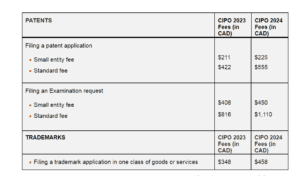
The Canadian Intellectual Property Office (“CIPO”) has announced that effective January 1, 2024, most official fees will be increasing by 25%. On the patent side, the increase in the fees will be applicable to standard entity size. At the same time, the definition of “small entity” in the Patent Rules will be broadened from the current 50 employees to fewer than 100 employees, which would mean that more companies can fall into the small entity category and thus utilize the lower official fees. Canada remains an important jurisdiction in North America for IP filings and is further reinforced by rapid population growth, surpassing the 40 million mark in 2023. The above changes are detailed below with some recommendations for saving on official fees.

Significant CIPO Fee Increase

Effective January 1, 2024, a one-time 25% fee increase will be implemented, impacting most patent, industrial design, trademark and copyright fees. With respect to patent matters, this increase will not apply to businesses qualifying as a “small entity” under the Patent Rules. Thus, small entity patent applicants will only experience CIPO’s regular annual fee increase in 2024.

Below are a few examples of changes in CIPO’s fees (rounded up):

A complete listing of fee increases relating to patents, industrial designs, trademarks, copyrights, and other fees can be found on CIPO’s website here.

Expansion of the definition of “Small Entity” under the Patent Rules

Another important change is the broadening of the definition of “small entity” in the Patent Rules. This change is important because entities that meet the definition of small entity and who submit a small entity declaration are entitled to a 50% reduction of some CIPO patent-related fees.

Currently, a “small entity” is defined as a university or an entity that employs 50 or fewer employees at the time the patent application was filed or at the national phrase entry date for an international PCT application but does not include:

(a) an entity that is controlled directly or indirectly by an entity other than a university, that has more than 50 employees, or

(b) an entity that has transferred or licensed, or has an obligation other than a contingent obligation to transfer or license, any right or interest in a claimed invention to an entity other than a university that has more than 50 employees

The definition of “small entity” will be amended effective January 1, 2024, to increase the maximum number of employees from 50 employees to fewer than 100 employees. Thus, more companies will be able to qualify for the small entity category and, as a result, utilize the lower small entity fees. Please note that small entity status is determined at the time of filing (or at the national phrase entry date) and is only determined once.

This amendment does not entitle newly qualifying small entities to a partial refund of fees paid before January 1, 2024. The amendment is, however, allowing applicants who had more than 50 employees but less than 100 employees at the time of filing (or at the national phrase entry date) to start paying future fees at the small entity rate after January 1, 2024, provided all other small entity conditions were met when the patent was filed, and a small entity declaration is submitted.

Recommendations

1. As a result of these changes, individuals and businesses are encouraged to review their IP portfolios with their IP professional for possible new filings, examination requests and renewal/maintenance fees that can be done before January 1, 2024, to take advantage of the lower 2023 rates before the 25% increase takes effect.

2. Additionally, applicants should also review with their IP professional whether they will qualify as of January 1, 2024, for the expanded small entity status.

For more information, please contact:
Randy Marusyk, Co-Managing Partner
T: 613-801-1088
E: rmarusyk@mbm.com


This article is general information only and is not to be taken as legal or professional advice. This article does not create a solicitor-client relationship between you and MBM Intellectual Property Law LLP. If you would like more information about intellectual property, please feel free to reach out to MBM for a free consultation.


Important CIPO Update – Amendments to Canadian Patent Rules

Canadian Intellectual Property Office (CIPO) just announced that the new amendments to the Canadian Patent Rules to ‘streamline examination’, including excess claim fees, will be coming into effect on October 3, 2022. The changes will include a $100/per claim fee for applications with more than 20 claims and a fee for continued examination after three office actions equal to the original examination fee. The amendments also add steps such as ‘notice of conditional allowance’.

As a result of these changes, we advise our clients to review their patent portfolios to determine which patents have over 20 claims and request examination for these patents before the October 3, 2022 date to avoid paying the access claim fees, as they would apply at the examination stage after this date.

We will follow up this announcement with more comprehensive coverage of the new changes to Canadian Patent Rules – stay tuned!


For more information please contact:

Claire Palmer, Ph.D., Senior Patent Agent
T: 613-801-0450
E: cpalmer@mbm.com

This article is general information only and is not to be taken as legal or professional advice. This article does not create a solicitor-client relationship between you and MBM Intellectual Property Law LLP. If you would like more information about intellectual property, please feel free to reach out to MBM for a free consultation.

Health Canada to Draft New Patented Medicine Prices Review Board Guidelines in the Wake of Pharmaceutical Victories

Canada’s Patented Medicine Prices Review Board (PMPRB) is a quasi-judicial body that has authority under the Patent Act to protect and inform Canadians “by ensuring that the prices of patented medicines sold in Canada are not excessive and by reporting on pharmaceutical trends”.[1]

Two recent decisions[2] from Canadian appellant courts surrounding the scope of the PMPRB’s authority under the Patent Act represent victories for the pharmaceutical industry, sending a strong signal that the PMPRB does not have the jurisdiction to consider consumer protection or general regulations of drug pricing in its determination of “excessive” pricing.

In response to these recent appellant decisions, the Canadian Minister of Health announced in April that there will be “a new and different set of guidelines” prepared for consultation in the coming months. Notably, these amendments will not include the proposed economic, regulatory factors for drug pricing nor the net price disclosure requirements held to be unconstitutional by the Quebec Court of Appeal.[3] The Minister of Health also stated that Health Canada will be implementing the “new basket of comparator countries” as an amendment to the Patented Medicines Regulations, which will come into force on July 1, 2022.[4] This amendment removes the US and Switzerland and adds Japan, Norway, Belgium, Australia, and the Netherlands as comparator countries.[5]

Importantly, while rights holders will need to begin reporting price information in accordance with the new comparator countries beginning on July 1, 2022, there will be a temporary period during which no guidelines will be in effect. During this period, the PMPRB will be holding expedited written consultation on what price tests should be applied, the details of which will be communicated once the new draft guidelines have been published in the Canadian Gazette. Once the new guidelines are finalized, rights holders will be provided with a reasonable period to become compliant.[6] Although the PMPRB is aiming to have these new draft guidelines published in a timely manner, no firm time frame has been established.

This response by the Canadian government should benefit pharmaceutical companies by ensuring that the PMPRB does not exceed its authority by considering consumer protection or general pricing regulations in its determination of “excessive” pricing. In the meantime, we anxiously await the release of the new PMPRB guidelines.


For more information please contact:

Claire Palmer, Ph.D., Senior Patent Agent
T: 613-801-0450
E: cpalmer@mbm.com


This article is general information only and is not to be taken as legal or professional advice. This article does not create a solicitor-client relationship between you and MBM Intellectual Property Law LLP. If you would like more information about intellectual property, please feel free to reach out to MBM for a free consultation.


[1] http://pmprb-cepmb.gc.ca/home

[2] Alexion Pharmaceuticals v. Canada (Attorney General) 2021 FCA 157
Merck Canada Inc. vs. Attorney General of Canada 2022 QCCA 240

[3] “Update – PMPRB Response to the April 14, 2022 statement from Minister of Health on the Coming-into-Force of the 2019 Regulations Amending the Patented Medicines Regulations” (April 22, 2022).

[4] Office of Honourable Jean-Yves Duclos, Minister of Health, “Statement from Minister of Health on the Coming-into-Force of the Regulations Amending the Patented Medicines Regulations” (April 14, 2022).

[5] “Regulations Amending the Patented Medicines Regulations (Additional Factors and Information Reporting Requirements): SOR/2019-298” Canada Gazette, Part II, Volume 153, Number 17.

[6] Office of Honourable Jean-Yves Duclos, Minister of Health, supra note 4.

Conference Posters and Materials: Beware! They Can Constitute Prior Art

In the academic world, it is common for researchers to attend and present their findings at conferences. Papers presented will typically end up as part of conference handouts or available online for future use. PowerPoint slides used in presentations are also sometimes published or distributed. Posters are often set up where attendees may view them. Conversations between researchers happen after presentations, and at numerous coffee breaks and networking events. In the publish or perish world of academia, conferences provide one of the best venues to present your ideas and research and meet with like-minded people.

Similarly, in the corporate world tradeshows are often used to show off products and demonstrate their features and capabilities to potential customers. Trade show booths often include demonstration systems, brochures, and marketing presentations that are only available for the two or three days of the show. Copies of brochures and presentations may be saved or may be destroyed afterwards.

Unfortunately, what is good for the sharing of information is often not good for the patenting of inventions that arise from the research and products presented at these conferences. The subject matter of a patent claim must not have been previously disclosed, and the invention must not be obvious to a person skilled in the art or science to which it pertains[1]. Conference presentations, presentation slides, and posters can all be prior art, whether they come from an inventor or someone else, and can prevent you from patenting your inventions.

Posters are an interesting case in that they may often be displayed for just a few hours, be viewed by passersby, and usually do not become part of the published conference proceedings. They are often untraceable or destroyed later. They often will not contain enough information to prevent an invention from being novel, but nevertheless may form part of the state of the art that must be considered when determining if an invention contains an inventive step.

In Biogen Canada Inc. v. Taro Pharmaceuticals Inc., 2020 FC 621, a poster was presented at a conference in Baltimore in 2002, 18 years previous. The poster was available to the court but had only been presented for a short time at the conference, and in the intervening years could not have been found even with a reasonably diligent search. Nevertheless, expert testimony established that the poster was indeed genuine and therefore its contents formed part of the state of the art in 2002 for determining obviousness of the patent claims in question. The poster, together with information found in other sources of prior art, were enough to find the patent claims in question obvious and invalid. This case is interesting since a poster, only presented for a short time at the conference and thereafter not being available, was used to establish the state of the prior art 18 years ago.

In Mediatube Corp. v. Bell Canada, 2017 FC 6 the plaintiff alleged that the defendant’s Fibe TV service could be modified to infringe its patents. Bell argued that all limitations of the relevant patent claims had been disclosed in a number of sources, including brochures and prototype systems that had been presented at the SuperComm tradeshow in June 1998, 19 years previous. Brochures were available to the court. Mediatube argued that the brochure was only disclosed at the tradeshow and could not be considered to have been available to the public as it could not later be found in a reasonably diligent search by a skilled person. With the help of expert testimony, the court decided that the brochures and presentations of the systems, despite only being available for a short time, were part of the state of the art at the time and could be considered when determining the validity of Mediatube’s patent claims.

On the other hand, in Valence Technology, Inc. v. Phostech Lithium Inc., 2011 FC 174, the defendant was challenging the validity of plaintiff’s patents. Phostech asserted that conference publications, presentations, and posters presented twelve years previous were prior art to at least some of the patent claims. The presenter had also had discussions while at the conference. The poster had since been destroyed and could not be presented to the court. When defining the common general knowledge at the key date the judge decided to exclude the presentations, posters, and any discussions that may have happened. Though not stated, this may have been because the poster had been destroyed and that there were no experts to testify to its contents or importance.

It is difficult to determine in advance if a poster will later be found to form part of the state of the art when considering patent validity. For prior art, such as a poster, that may only be presented for a few hours at a scientific or industry conference, it is uncertain whether it can be considered part of the body of prior art of which a person skilled in the art could be said to possess, especially since it may not be found later even through a reasonably diligent search. Like any disclosure, the best practice is to:

1. Review all public disclosures, even those that are short-lived and will be unavailable later.

2. Be careful what kind of information you put on a poster. Try to use more general information on all conference materials if possible.

3. If you must disclose detailed information, restrict any disclosures to individuals or groups in a non-public space under NDA.

4. File a provisional or utility patent application before the event.

5. Review and document what others present. Smartphones make it easy.

Better to be safe than sorry!

If you are considering filing a patent and are worried about your conference/event disclosure, please feel free to contact MBM for a free consultation.

T: 613-567-0762
E: patents@mbm.com


This article is general information only and is not to be taken as legal or professional advice. This article does not create a solicitor-client relationship between you and MBM Intellectual Property Law LLP. If you would like more information about intellectual property, please feel free to reach out to MBM for a free consultation.

[1] Canadian Patent Act 28.2 and 28.3. https://laws-lois.justice.gc.ca/eng/acts/P-4/page-10.html#docCont

Late Report of Patent Grant leads to Irretrievable Loss of Drug Patent Register Listing Rights

Merck Canada Inc. v Canada (Health), 2021 FC 345

The grant of a patent containing a claim that relates to a medicine or use of the medicine approved by Health Canada triggers a 30-day deadline from the date of payment of the final fee to list the patent on the Patent Register maintained by the Therapeutic Products Directorate. A careful review of the timing of the grant after payment of the Final Fee (i.e., Issue Fee) in this case and the Canadian Intellectual Property Office’s service standards offers valuable lessons.

In this decision, the Federal Court (the “FC”) dismissed an application for judicial review brought by Merck Canada Inc. (“Merck”) over the refusal by the Minister of Health (the “Minister”) to add Canadian Patent No. 2,830,806 (the “‘806 Patent”) to the Patent Register pursuant to section 4(6) of the Patented Medicines (Notice of Compliance) Regulations (the “PM(NOC) Regulations”).

BACKGROUND

Merck markets KEYTRUDA®, a biologic drug for the treatment of certain advanced-stage cancers. The ‘806 Patent was issued on May 12, 2020, and contains claims that are directed to a formulation of the drug KEYTRUDA®.

The issuance of the ‘806 Patent was not reported by the Canadian patent agent retained by Merck’s American parent company (“Merck USA”) until June 15, 2020, more than a month after the patent had issued. Merck USA had however independently learned of the issuance on June 12, 2020 and immediately instructed Merck to take the necessary next steps. Patent lists were submitted the same day, but after the close of business, and were therefore deemed to have been filed on Monday, June 15, 2020.

On June 19, 2020, the Minister informed Merck of the preliminary determination that the patent lists relating to the ‘806 Patent were ineligible for being submitted outside of the 30-day window stipulated in section 4(6) of the PM(NOC) Regulations. Merck replied with written representations and affidavit evidence.

The Minister later confirmed on November 6, 2020 that the patent lists relating to the ‘806 Patent were ineligible for inclusion on the Patent Register holding, among other elements, that the Time Limits and Other Periods Act (COVID-19) (the “Time Limits Act”) does not extend the deadline within which first persons may submit patent lists in accordance with s 4(6) of the PM(NOC) Regulations; and that the 30-day deadline in section 4(6) of the PM(NOC) Regulations is not discretionary.

ANALYSIS

Merck argued that the Minister’s refusal would deprive the patent holder of substantial protections available under the PM(NOC) Regulations. Additionally, Merck said it would suffer prejudice because a subsequent entrant would be able to file a drug submission after the expiry of the six-year “no file” period for KEYTRUDA®, on May 19, 2021.

The issues, in this case, were a) was the Minister’s determination reasonable that the Time Limits Act cannot be applied here and as a result cannot suspend the 30-day time period specified in section 4(6) of the PM(NOC) Regulations? And b) was the Minister’s determination reasonable that she had no discretion to extend the 30-day time period specified in section 4(6) of the PM(NOC) Regulations?

The FC determined that the Minister’s decision would be subject to review against the standard of reasonableness, meaning the FC would only intervene if “there are sufficiently serious shortcomings in the decision such that it cannot be said to exhibit the requisite degree of justification, intelligibility and transparency.”

With regard to the reasonableness of the Minister’s determination, that the Time Limits Act did not cause suspending of the 30-day time period specified in section 4(6) of the PM(NOC) Regulations, the FC found that the Time Limits Act applied in only three circumstances: limitation or prescription periods for commencing a proceeding before a court; time limits for doing something in a proceeding before a court; and time limits where a party makes an application for leave of a court, either to commence a court proceeding or to do something in relation to a court proceeding. Merck asserted that section 4(6) of the PM(NOC) Regulations functions as a “gateway” to the summary litigation provisions that begin at section 6(1), and therefore Merck argued that the 30-day period specified in section 4(6) of the PM(NOC) Regulations is a “limitation period within a limitation period.” The FC concluded that the listing of a patent on the Patent Register pursuant to section 4(6) of the PM(NOC) Regulations is too remote from the commencement of a court proceeding under section 6(1) to constitute a “limitation period within a limitation period” for the purpose of section 6(1) of the Time Limits Act.

With regard to the Minister’s determination that she had no discretion to extend the 30-day time period specified in section 4(6) of the PM(NOC) Regulations being reasonable, Merck relied on a previous FC decision to argue that the Minister may add a “late” patent list to the Patent Register. The FC was not convinced of this argument though, maintaining that it is well established that the timelines prescribed by the PM(NOC) Regulations are exact. The FC further added that the 2017 amendments to the PM(NOC) Regulations also did not confer any new discretionary powers to the Minister.

The FC concluded that the Minister’s decision was justified, intelligible and transparent, and therefore reasonable. No costs were awarded by agreement of the parties.

COMMENTARY

A patent will only issue in Canada following payment of the Final Fee. The Client Service Standards at CIPO for grant of a patent after payment of the Final Fee is stated as being within 12 weeks (Client Service Standards – Canadian Intellectual Property Office).

The Final Fee for the ‘806 application was paid on March 20, 2020. The ‘806 patent granted 53 days later (about 7½ weeks) well before the 12 weeks service standard. A brief review of recently issued patents in Canada indicates that the quick grant of the ‘806 patent was not an anomaly and that patents are regularly granting within 6 to 8 weeks of payment of the Final Fee.

A key takeaway from this case is that once the Final Fee is paid for applications that are eligible for listing on the Patent Register, the CIPO database should be monitored closely for grant of the patent. To help with that, CIPO now also lists “Forecast Issue Date” on the Administrative Status page for each patent application and further sends a notification by email that the patent has granted. Please note that this is also applicable when filing a divisional application after payment of the Final Fee.

For more information please contact:

Claire Palmer, Ph.D., Senior Patent Agent
T: 613-801-0450
E: cpalmer@mbm.com

This article is general information only and is not to be taken as legal or professional advice. This article does not create a solicitor-client relationship between you and MBM Intellectual Property Law LLP. If you would like more information about intellectual property, please feel free to reach out to MBM for a free consultation.

What Are the Risks of Not Patenting Your Invention?

Companies large and small often think long and hard about whether to patent their products. For small companies and startups, it is often a question of limited time and money. For larger companies, budget is also a concern, but often it is also the time required of inventors to adequately document an invention disclosure and to work with a patent professional. Often, a patent inventor is also a company executive such as the CEO or CTO and their time is limited.

So, what happens if you decide not to patent? What are the possible drawbacks? What are the risks?

A patent can be looked at in several ways:

  • It can be viewed as a type of insurance: if someone copies my invention or if someone else tries to patent the same invention or a very similar one.
  • It can also be looked at as an investment.

– It may allow you to gain access to a competitor’s patents by licensing your patents to them in return.

– Filing a patent might be necessary or very helpful in obtaining financing from investors.

  • It also allows you to license your invention to others and collect a royalty fee. Technology licensing can be very important for a small company that may lack the resources to fully benefit from their invention.

One of the first things to consider is whether a competitor or third party can figure out your invention based on seeing your product in use, by simply viewing it, or by reverse engineering it. For some inventions, it is clear what is being done as soon as you see it. For other inventions, it can take a significant amount of analysis to figure it out. The more your invention is successful and popular, the more incentive there is for someone to try to determine how it works. Without patent protection, once someone has figured it out there is nothing stopping them from using it themselves.

Another thing to consider is what happens if someone else patents your invention independently. For certain pressing problems, there may be several different teams looking for a solution simultaneously. If you decide not to patent your solution, someone else may patent theirs first and it may be sufficiently broad to encompass what you are doing as well. Luckily, if you are already practicing your invention before the other patent is filed or published, depending on the jurisdiction, you may continue to do so. However, this can quickly get complicated as you may be called upon to prove that your use of your invention predates your competitor’s patent. Things can also become more complicated if you decide to sell your business or a portion of your business. Can the buyer practice your invention, or can you continue to do so? If your exit plan involves a possible sale of your company, the lack of a patent or the presence of a competing patent could be a real barrier to you realizing your goals.

To make the right decision whether to patent or not, here are some things to consider:

1. Can a competitor easily figure out your invention from your product?

2. Would someone else obtaining a patent that covers your invention overly restrict your business plan and options?

3. Is the cost of a patent reasonable given your investment in product development and predicted sales?

4. Do you require a patent as insurance when working with partners or manufacturers?

If you do decide that filing a patent is the right decision, here are a few steps you should take:

1. Be careful not to disclose your invention or offer it for sale before filing your patent application as it may prevent you from obtaining the patent.

2. Remember that the first to file gets the patent, so don’t delay filing your patent too long or someone else might beat you to it.

3. Take advantage of any government programs that help with funding for patent applications.

No matter what you decide, we recommend that you consult with a patent professional to evaluate the risks and tradeoffs of your patenting decision.

For more information, please contact:

T: 613-567-0762
E: patents@mbm.com

This article is general information only and is not to be taken as legal or professional advice. This article does not create a solicitor-client relationship between you and MBM Intellectual Property Law LLP. If you would like more information about intellectual property, please feel free to reach out to MBM for a free consultation.

Foreign Prosecution History: To Admit, Or Not To Admit, That Remains a Puzzle To Canadian Courts

CanMar Foods Ltd. v. TA Foods Ltd.2021 FCA 7

Section 53.1 of the Patent Act has brought about a significant shift in the Canadian approach to file wrapper estoppel by enabling the introduction of a patent’s prosecution history during claim construction. Prosecution files are now admissible to rebut a patentee’s representation that attempts to recapture ground conceded during the patent prosecution to avoid prior art.

In a unanimous decision, the Federal Court of Appeal (“FCA”) concluded that the Federal Court (“FC”) should have refrained from considering the prosecution history of the corresponding US Application at the trial level. However, whether the prosecution history of a foreign application can ever be considered pursuant to section 53.1 of the Patent Act is still unclear.

BACKGROUND

CanMar Foods Ltd. (“CanMar”) and TA Foods Ltd. (“TA”) are two Saskatchewan corporations competing in the business of manufacturing flax seed products. CanMar alleged that TA infringed its patent (the “376 Patent”) entitled “Methods for Roasting Oil Seed, and Roasted Oil Seed Products.” However, TA argued that its oil seed roasting or cooking process fell outside the claims of the ‘376 Patent. Specifically, TA’s process neither heated oil seed in a “stream of air” nor maintained the oil seed in an “insulated roasting chamber or tower.” Furthermore, these two limitations were added by CanMar during the prosecution of the corresponding US Patent Application (the “405 Application”).

In contrast, TA only used a Micronizer for heating oil seed via infrared radiation. Moreover, it was determined that the hoppers and the cooling tower of the Micronizer were clearly uninsulated. Therefore, TA claimed that no infringement could be found on the essential elements of the ‘376 Patent.

The trial judge considered two issues: first, CanMar expressly acknowledged that the claims of the ‘376 Patent had been amended to be substantially the same as the corresponding claims of the ‘405 Application in the United States; second, CanMar admitted that the amendments had limited the scope of the claims in order to overcome the novelty and obviousness concerns raised before the USPTO.

Therefore, the trial judge concluded that the language of section 53.1 generally should be limited to communications between the patentee and the Canadian Patent Office. However, consideration of foreign prosecution histories may be permissible as part of a purposive construction of the claims of the ‘376 Patent in such “extraordinary circumstances”.

Given that TA’s roasting process did not comprise the two essential elements at issue, the trial judge held that TA did not infringe any claims of the ‘376 Patent.

ANALYSIS

In the appeal decision, the FCA considered the scope of section 53.1 and whether it should cover communications between patentees and foreign patent offices.

The FCA found that the trial judge’s heavy reliance on the US case of Abbott Labs v. Sandoz, 566 F.3d 1282 (2009) [Abbott Labs] was inappropriate. In Abbott Labs, the US patent claimed priority from the application of the foreign patent which necessarily entailed that express reference to the foreign patent was made. Such was not the case here. Another US case, Paice LLC, The Abell Foundation, Inc. v. Ford Motor Company, 881 F.3d. 894 (2018) was found to be more relevant, citing that “[t]o incorporate material by reference, the host document must identify with detailed particularity what specific material it incorporates and clearly indicate where that material is found in the various documents.”

However, CanMar only mentioned briefly in a response to the Examiner that “new claims 1-19 correspond substantially to those submitted during prosecution of a related United States application.” The FCA held that it would be a far stretch to say the prosecution of the US Application was incorporated by reference when the specific application was not even cited within the document.

Furthermore, the FCA considered the public policy reasons and held that allowing foreign patent prosecution history into the analysis might lead to overly contentious and expensive litigation. While the global system has become more interconnected, some differences lie in the respective registration processes and the languages of patent claims. For example, a party may disclaim an element in one country that they do not have to disclaim in another, and the potential issues of translation may lead to major problems in the interpretation of the claims as well.

That being said, the FCA also pointed out that one should not underplay the public interest in keeping those previously disclaimed elements from being re-claimed in future infringement cases.

In conclusion, the FCA ruled that the corresponding US prosecution history should not be considered, but wished to express no firm views on the broader issue of whether the prosecution history of a foreign application can ever be considered pursuant to section 53.1 of the Patent Act. As a result, the FCA simply upheld the underlying decision that TA did not infringe the ‘376 Patent at issue and that CanMar’s appeal should be dismissed.

COMMENTARY

Before the introduction of section 53.1 of the Canadian Patent Act, it was very clear that the prosecution history in another jurisdiction was inadmissible for the purpose of claim construction. In this case, section 53.1 of the Patent Act is perceived as a step to better align Canadian law with its UK and US counterparts.

The importance of the trial level decision was significant, as it was the first case in Canada to interpret the purpose of section 53.1 and how it compares to the application of file wrapper estoppel in the UK and the United States. The broader issue of whether the prosecution history of a foreign application can ever be considered will be left to the courts to clarify in future decisions.

If you are dealing with an IP litigation issue, please feel free to reach out to MBM for a free consultation

For more information, please contact:

T: 613-567-0762
E: patents@mbm.com

This article is general information only and is not to be taken as legal or professional advice. This article does not create a solicitor-client relationship between you and MBM Intellectual Property Law LLP. If you would like more information about intellectual property, please feel free to reach out to MBM for a free consultation.

Top Top