To Translate or not to Translate? MBM Provides General Guide for Businesses Operating in the Province of Québec after June 1, 2025

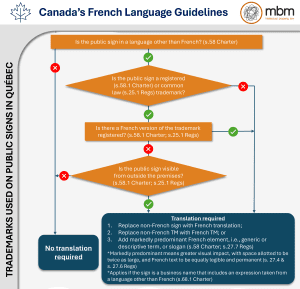
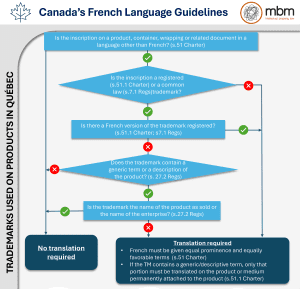
If you sell products or have public signage in the Province of Québec, then please consider what changes, if any, will be necessary to the product inscriptions/packaging and signage to ensure compliance with the amendments to the Charter of the French Language, c-11, which came into force on June 1, 2025.

To assist with your review, MBM has prepared the following flow charts:


MBM has developed creative solutions to minimize product inscriptions/packaging and signage changes and yet still be in compliance with the amendments to the Charter of the French Language, c-11, which came into force on June 1, 2025. The flow charts are provided only as a general guide based on known amendments to the Charter of the French Language, c-11. Future amendments or regulations may impact the information provided above.

If you would like to learn more or require any advice, please contact:

Scott Miller, Co-Managing Partner, Head of the Litigation Department
T: 613-801-1099
E:  smiller@mbm.com

Deborah Meltzer, Partner, Lawyer & Trademark Agent
T: 613-801-1077
E: dmeltzer@mbm.com


This article is general information only and is not to be taken as legal or professional advice. This article does not create a solicitor-client relationship between you and MBM Intellectual Property Law LLP. If you would like more information about intellectual property, please feel free to reach out to MBM for a free consultation.

Government IP Funding Programs Across Canada

Securing intellectual property (IP) rights is a critical step for businesses, particularly for start-ups and small or medium-sized enterprises (SMEs), who want to gain a competitive advantage in the marketplace. To assist in funding IP-related costs, various government funding programs have been developed across Canada to help companies secure IP rights.

Below are some common funding programs available across Canada.

Elevate IP:

ElevateIP is a federal program delivered Canada-wide through selected business accelerators and incubators (BAIs) in collaboration with regional partners to help start-ups develop and implement IP strategies, in addition to offering IP education services.

While eligibility requirements and funding amounts vary depending on the BAI administering the program, start-ups may be eligible for up to $100,000 to develop and implement an IP strategy. Most BAIs require, at a minimum, that the start-up have less than 500 employees and be headquartered in the geographic region of the BAI administering the program. The program funding is divided into 3 tiers:

  1. IP Education & Awareness
  2. IP Strategy Development
  3. IP Strategy Implementation

The selected BAIs in different provinces are listed below:

To learn more about the Elevate IP program, please click here.

IP Assist (IRAP):

IP Assist, administered by The National Research Council of Canada Industrial Research Assistance Program (NRC IRAP), is a tiered national funding program designed to support SMEs’ IP efforts. Under the IP Assist Program, SMEs can receive support and funding across three different levels:

  • L1 – IP Awareness
  • L2 – IP Strategy
  • L3 – IP Action

The funding available for IP Strategy and IP Action ranges from $10,000 to $25,000 for each, with an additional $1,000 for IP awareness. To learn more about the IP Assist program, please click here.

Intellectual Property Ontario (IPON):

IPON is a provincial-run program that provides support to Ontario-based SMEs operating in one of IPON’s served sectors – MedTech, life sciences, artificial intelligence, vehicle technology, and mining and advanced manufacturing – to promote innovation and growth in these highly desired sectors in Ontario. Once the SME is enrolled as an IPON client and is part of IPON’s IP Bootcamp or Partner Program, it may be eligible for up to $35,000 in initial funding for IP protection and commercialization services and have potential access to future IP funding of up to $100,000. It’s important to note that the SME has to cover 20% of IP service costs directly, and IPON covers 80%. To learn more about the IPON program, please click here.

Innovation Access Collective (IAC):

IAC is a membership-based not-for-profit organization funded by the Government of Canada to assist Canadian SMEs in the data-driven CleanTech sector with IP-related needs. Full members may be eligible for grant funding ranging from $5,000 to $20,000, while associate members may be eligible for grant funding ranging from $5,000 to $10,000. In addition, IAC also has a Grant for Women in IP created in response to the demonstrated inequitable gender balance in the IP ecosystem. To learn more about the IAC program, please click here.

CanExport Innovation:

CanExport Innovation provides funding for intellectual property protection in international markets and other related services for Canadian SMEs looking to expand into international markets to develop R&D collaborations through partnerships in foreign markets. Businesses may be eligible for funding of up to $75,000 to assist with research and development (R&D) for a single technology. To learn more about the CanExport Innovation program, please click here.

Eligibility requirements and application process:

Please note the information presented in this article represents only a general outline and the above programs are subject to specific eligibility requirements that are listed on their respective websites that are linked above. For more information, please reach out to an MBM professional who can assist you in determining the best funding program for your business and assist you through the application process.

While some of the above programs accept applicants on a “rolling basis”, other programs require applicants to apply to open calls subject to strict deadlines. We strongly encourage businesses looking to apply to consult the program websites linked in this article for further information regarding eligibility criteria, program application process and deadlines.

MBM is an approved service provider for ElevateIP, IP Assist, and IPON.

If you would like to learn more or require any advice, please contact:

Kay Palmer, Ph.D., Senior Patent Agent
T: 613-801-0452
E:  kpalmer@mbm.com
This article is general information only and is not to be taken as legal or professional advice. This article does not create a solicitor-client relationship between you and MBM Intellectual Property Law LLP. If you would like more information about intellectual property, please feel free to reach out to MBM for a free consultation.

CIPO Fees to Increase by 25% in 2024 and Expansion of the Definition of “Small Entity”

The Canadian Intellectual Property Office (“CIPO”) has announced that effective January 1, 2024, most official fees will be increasing by 25%. On the patent side, the increase in the fees will be applicable to standard entity size. At the same time, the definition of “small entity” in the Patent Rules will be broadened from the current 50 employees to fewer than 100 employees, which would mean that more companies can fall into the small entity category and thus utilize the lower official fees. Canada remains an important jurisdiction in North America for IP filings and is further reinforced by rapid population growth, surpassing the 40 million mark in 2023. The above changes are detailed below with some recommendations for saving on official fees.

Significant CIPO Fee Increase

Effective January 1, 2024, a one-time 25% fee increase will be implemented, impacting most patent, industrial design, trademark and copyright fees. With respect to patent matters, this increase will not apply to businesses qualifying as a “small entity” under the Patent Rules. Thus, small entity patent applicants will only experience CIPO’s regular annual fee increase in 2024.

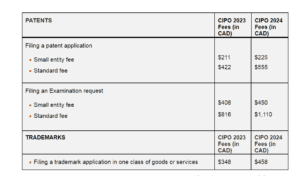
Below are a few examples of changes in CIPO’s fees (rounded up):

A complete listing of fee increases relating to patents, industrial designs, trademarks, copyrights, and other fees can be found on CIPO’s website here.

Expansion of the definition of “Small Entity” under the Patent Rules

Another important change is the broadening of the definition of “small entity” in the Patent Rules. This change is important because entities that meet the definition of small entity and who submit a small entity declaration are entitled to a 50% reduction of some CIPO patent-related fees.

Currently, a “small entity” is defined as a university or an entity that employs 50 or fewer employees at the time the patent application was filed or at the national phrase entry date for an international PCT application but does not include:

(a) an entity that is controlled directly or indirectly by an entity other than a university, that has more than 50 employees, or

(b) an entity that has transferred or licensed, or has an obligation other than a contingent obligation to transfer or license, any right or interest in a claimed invention to an entity other than a university that has more than 50 employees

The definition of “small entity” will be amended effective January 1, 2024, to increase the maximum number of employees from 50 employees to fewer than 100 employees. Thus, more companies will be able to qualify for the small entity category and, as a result, utilize the lower small entity fees. Please note that small entity status is determined at the time of filing (or at the national phrase entry date) and is only determined once.

This amendment does not entitle newly qualifying small entities to a partial refund of fees paid before January 1, 2024. The amendment is, however, allowing applicants who had more than 50 employees but less than 100 employees at the time of filing (or at the national phrase entry date) to start paying future fees at the small entity rate after January 1, 2024, provided all other small entity conditions were met when the patent was filed, and a small entity declaration is submitted.

Recommendations

1. As a result of these changes, individuals and businesses are encouraged to review their IP portfolios with their IP professional for possible new filings, examination requests and renewal/maintenance fees that can be done before January 1, 2024, to take advantage of the lower 2023 rates before the 25% increase takes effect.

2. Additionally, applicants should also review with their IP professional whether they will qualify as of January 1, 2024, for the expanded small entity status.

For more information, please contact:
Randy Marusyk, Co-Managing Partner
T: 613-801-1088
E: rmarusyk@mbm.com


This article is general information only and is not to be taken as legal or professional advice. This article does not create a solicitor-client relationship between you and MBM Intellectual Property Law LLP. If you would like more information about intellectual property, please feel free to reach out to MBM for a free consultation.


MBM Prevails as Federal Court Awards Unprecedented 50% Lump Sum Award of Costs in Trademark Dispute

On August 15, 2022, the Federal Court of Canada issued its decision with respect to costs in Dragona Carpet Supplies Mississauga Inc. v Dragona Carpet Supplies Ltd and FlooReno Building Supplies Inc., 2022 FC 1200, ordering one of the highest lump sum costs ever awarded in a trademark dispute, representing 50% of aggregate fees incurred, plus disbursements.

The decision was the culmination of a factually complicated family dispute related to the right to use and own the trademark “DRAGONA” in specified pockets of the GTA. The Defendants/Plaintiffs by Counterclaim were wholly successful in (1) defending against the Plaintiff’s motion for summary trial with respect to its claim of passing off, and (2) their own motion for summary trial with respect to their claim for expungement of three of the Plaintiff’s registered “DRAGONA” trademarks.

Ultimately, the Federal Court preferred the evidence of the Defendants. Although there was disagreement on the majority of the facts presented throughout the proceedings, the parties unequivocally agreed that the Defendant, Dragona Carpet Supplies Ltd., was the first to use the trademark DRAGONA. Based on the evidence, there was no basis for the Plaintiff to argue that it was entitled to the trademark registrations. In granting an exceptional lump sum cost award of 50% to the Defendants, the Court emphasized that in light of the facts, the Plaintiff ought never to have maintained the legitimacy of the trademark registrations, much less, waited until the commencement of the hearing to abandon its position.

This precedent-setting decision not only expanded the law on concurrent-use passing off and care and control in the context of a license, but further substantiates the Federal Court’s recent trend of opting for lump sum cost awards in lieu of the tariff, which represents a more reasonable and realistic recovery of legal fees for the successful party.


For more information please contact:

Scott Miller, Co-Managing Partner, Head of the Litigation Department
T: 613-801-1099
E:  smiller@mbm.com

Deborah Meltzer, Partner, Lawyer, & Trademark Agent
T: 613-801-1077
E: dmeltzer@mbm.com


This article is general information only and is not to be taken as legal or professional advice. This article does not create a solicitor-client relationship between you and MBM Intellectual Property Law LLP. If you would like more information about intellectual property, please feel free to reach out to MBM for a free consultation.

New Trademark Laws For Québec – What You Need To Know

In approximately three years or less, the Québec Government’s newly adopted Bill 96, An Act respecting French, the official and common language of Québec will go into force. Bill 96 will have a significant impact on the use of English trademarks in the Province of Québec. For example, whereas in the past, both unregistered and registered trademarks did not need to be translated into French, under Bill 96, only registered trademarks will be exempt from translation into French. Currently, it takes approximately two years for a trademark application to mature to registration in Canada. As such, it is imperative businesses review their trademark portfolios and consider which trademarks ought to be filed for registration to ensure continued use in the Province of Québec.

The Present Rules in Québec:

Promotional Material/Packaging
At present, a “recognized trademark” is exempt from translation requirements in Québec. A recognized trademark includes a registered trademark, an applied-for trademark with a pending application, or a common law trademark. As such, unless the English trademark has been registered in French, it is not necessary to translate the English trademark registered or common law (unregistered) on packaging offered in Québec into French.

Signage
Currently, in Québec, outside signage, inside signage that is seen outside, mall signage and/or signage on a pole/column (with some exceptions) displaying an English registered or common law (unregistered) trademark does not need to be translated into French. However, if the equivalent French trademark is a registered trademark, then the French trademark must be used on the signage. In any event, if there is only an English trademark, unlike packaging or promotional material, the signage must have “sufficient presence” in French and include:[1]

  • A generic term or a description of the products or services;
  • A slogan; or
  • Any other term or indication favouring the display of information pertaining to the products or services to the benefit of consumers or persons frequenting the site (location).

The “sufficient presence” of French means that it should be displayed with permanent visibility and legibility in the same visual field as the non-French mark, although not necessary to be present side-by-side, in the same number, in the same materials or in the same size.[2]

Exception: If the English trademark is displayed on a pole/column and there are more than two trademarks on the pole/column then the signage does not need to disclose the generic term, slogan or other terms in French.  The typical situation would be the external signage of the parking lot entrance for an outdoor mall.[3]

Bill 96 – New Requirements in Québec for French in Trademarks:

When Bill 96 goes into effect, the scope of the “recognized trademark” exemption is greatly reduced.

First, only non-French registered trademarks will be exempt and not need to be translated into French. As such, an unregistered (i.e., applied-for or common law) English trademark will need to be accompanied by its French equivalent on commercial advertising and public signage.

Second, even if a non-French trademark is registered but is used on public signs and posters visible from the outside of a premise, the signage must still have a generic term, slogan or other term in French marked predominately in French.[4] Predominantly means that the space allotted to the French text must be at least twice as large as the space allotted to the non-French text, or the characters used in the French text must be at least twice as large as those used in the non-French text.[5]

Implications of the New Québec Language Laws:

It is expected that the newly adopted Québec language laws will be in force in three years or less.  Currently, it takes approximately two years for a trademark application to mature to registration in Canada. As such, if you offer goods and/or services in Québec and do not want to run afoul of the new Québec language laws, then it is imperative for you to review your trademark portfolios and consider a tailored solution to meet your business goals (for example, filing trademark applications with the Canadian Intellectual Property Office immediately).

Notably, these implications may not only affect English language trademarks but also trademarks using other non-French languages and potentially “coined” words.


For more information, please contact:
Scott Miller, Co-Managing Partner, Head of the Litigation Department
T: 613-801-1099
E: smiller@mbm.com


This article is general information only and is not to be taken as legal or professional advice. This article does not create a solicitor-client relationship between you and MBM Intellectual Property Law LLP. If you would like more information about intellectual property, please feel free to reach out to MBM for a free consultation.


[1] Regulation respecting the language of commerce and business, CQLR c C-11, r 9, ss 25(4) and 25.1.
[2] CQLR c C-11, r 9, s 25.3.
[3] CQLR c C-11, r 9, s 25.2(1).
[4] Bill 96, An Act respecting French, the official and common language of Québec, 1st Sess, 42nd Leg, Québec, 2021, cl 47 (assented to 1 June 2022).
[5] CQLR c C-11, r 11.

Taste, Smell, Sound, Touch, and Sight – Appealing to All Five Senses with Non-Traditional Trademarks

Words and logo designs tend to steal the show when it comes to what many typically associate with the term “trademark”. What is often underrepresented is that trademarks can be used to interact with consumers beyond their two-dimensional, visual components. In June of 2019, the Canadian Trademarks Act was amended and now includes a slew of non-traditional trademarks, such as three-dimensional shapes, colours in abstract, moving images, modes of packaging goods, smells, tastes, sounds, positions, textures, and holograms.

The expansion of the legal definition of a trademark in Canada, in conjunction with the potential perpetual term of protection, offers brand owners significant incentive to employ a multi-pronged approach in the protection of their products and services. Various unique elements of a product or unique features of consumer experience in the performance of a service may be protected as trademarks. By way of illustration, in practice, this can include the unusual shape of a bottle, the exclusive scent of a store, a catchy jingle, or the texture of a handbag. But like all good things, there is a catch. The Trademarks Act includes certain limitations which restrict the availability of non-traditional trademark protection.

Trademark protection cannot be extended to features which are dictated primarily by utilitarian function, in relation to the associated goods and services (s.12(2) of the Trademarks Act), nor can they unreasonably limit the development of any art or industry (s.18.1 Trademarks Act). For instance, it is unlikely that the taste of mint could be trademarked in association with gum, or a flowery scent trademarked in association with perfume, as these features are dictated by the functional aspect of the respective goods and would unreasonably limit the art and/or industry. On the contrary, the taste of mint in association with lipstick, or a flowery scent in association with stationary would likely not contravene the Trademarks Act. These provisions are also largely intended to remove the possibility of extending perpetual trademark protection to features which would otherwise be protected through a patent. In fact, the Lego® brick was famously the subject of this exact dispute before the Supreme Court of Canada.[1]

Moreover, at the examination stage, unlike in the case of a traditional trademark, the Canadian Trademarks Office will typically require evidence of distinctiveness of the applied-for non-traditional trademark. This means that the applicant would need to prove that the trademark has amassed sufficient reputation in Canada, to the point where the average Canadian consumer has been adequately educated as to its trademark status. This is often referred to as a “secondary meaning” since the evidence would need to demonstrate that the trademark’s overwhelming reputation causes consumers to dispense of its primary meaning. A classic example is the Coke® bottle. A bottle containing cola (primary meaning) is not specific to a single source, however the Coke® bottle is instantly identifiable, even when stripped of its label, because of the tremendous consumer recognition of that particular bottle shape belonging to Coca-Cola (secondary meaning). As such, it is advisable that a brand owner has several years of use of their non-traditional trademark and compile detailed evidence of the trademark’s reputation prior to formally applying for its registration with the Canadian Trademarks Office.

In creating marketing strategies, brand owners should consider the proprietary potential in thinking “outside the [traditional] box”. For example, in contemplating protecting a unique shape as a trademark, brand owners should consider taking advantage of the monopoly afforded by an industrial design in order to secure exclusivity and reputation in the shape, prior to filing for trademark protection. All things considered, creative branding strategists should venture beyond the conventional two-dimensional eye candy appeal of words and logos, and contemplate trademarks which can be perceived in three dimensions, felt, smelt, tasted or heard.

Despite the potential challenges with acquiring registrations for non-traditional trademarks, our team is accustomed to developing tailored non-traditional trademark strategies designed to properly position brand owners for success. If you are thinking of protecting a non-traditional branding element as a trademark, we would love to chat. MBM offers initial consultations at no charge.

For more information please contact:

Deborah Meltzer, Partner, Lawyer, & Trademark Agent
T: 613-801-1077
E: dmeltzer@mbm.com

This article is general information only and is not to be taken as legal or professional advice. This article does not create a solicitor-client relationship between you and MBM Intellectual Property Law LLP. If you would like more information about intellectual property, please feel free to reach out to MBM for a free consultation.


[1] Kirkbi AG v. Ritvik Holdings Inc. / Gestions Ritvik Inc., 2005 SCC 65

Tips For Startups: How To Make Sure Your IP Is Working For You

Two things that startups never seem to have enough of are: time and money. It can be difficult to carve out enough of both to properly identify, manage, and protect your intellectual property (IP). Your IP, including your patents, industrial designs and trademarks, is at the center of your company’s value. As a result, protecting your IP is crucial and will give your company the boost it needs to succeed in a competitive marketplace. Knowing your IP is essential to identifying your competitive advantage, focusing your R&D efforts, and creating an innovative company culture. IP should be the main component of your business plan and your pitch to customers and investors as it is normally your main selling point.

As a startup, you already have passion for your business, and you are convinced that you will be successful. Now, in order to apply your passion to the right strategy, you should ask yourself a series of questions to help pinpoint and identify what IP you currently possess and if it is valuable:

  • What you are doing that is new? What new features have you added, or improvements have you made lately?
  • What makes your product better, or faster, or more accurate, or more efficient than your competitor’s products?
  • What features of your product do customers value the most when making purchasing decisions?
  • Is your company name or logo unique in your industry? Did you check to make sure no one else has it registered as a trademark?
  • Have you designed a new product with a distinctive name, product shape, physical design or packaging?
  • Once you choose your name and logo, have you been consistently using it on your products, packaging, marketing materials, your website and your social media? Document the date you first used it!

One way to answer these questions is to formally evaluate your IP, you could use an IP law firm to do it, which is always recommended but you could also try to figure it out yourself by doing some market and competitor research.

Ideas born from your IP evaluation can form the basis for the future direction of your R&D, which will eventually turn into more patents, industrial designs, and trademarks that you will want to protect and leverage going forward.

Now that you have defined your “secret sauce” you can use it in several ways:

  • File a patent to demonstrate that you have a technological advantage important enough that you are willing to invest in a patent to protect it.
  • Gain credibility with financial investors and VCs. Include it in your pitch and highlight it in your business plan.
  • Get your sales and marketing people to highlight the IP incorporated into your products when interacting with customers.
  • Use your IP to develop and foster a culture of innovation in your company. Celebrate inventors to encourage the generation of new ideas.
  • Leverage your IP to form strategic partnerships and alliances to scale up your business or license out your IP for royalty revenue.
  • Build and protect your brand by consistently monitoring your trademarks to make sure no competitors are using them, and cause customers to mistake a competitor’s product for yours.

Your IP is already there. However, you need to take the time to identify it, protect it, then learn how to artfully articulate it to investors and customers to get the most out of it.

For more information, please contact:

T: 613-567-0762
E: general@mbm.com

Author: David Fraser, Patent Agent


This article is general information only and is not to be taken as legal or professional advice. This article does not create a solicitor-client relationship between you and MBM Intellectual Property Law LLP. If you would like more information about intellectual property, please feel free to reach out to MBM for a free consultation.

Don’t Let Your Trademark Go Up In Smoke: “smoking is cool” Branding Is Prohibited Under Canada’s Cannabis Act

In Canada, trademark registration is an important form of intellectual property protection for brand-owners as it confers the right to exclude others from using confusingly similar trademarks across Canada. Having said that, brand-owners in the cannabis space looking to register their name or logo as a trademark face a unique challenge; a trademark registration does not mean the trademark itself can be lawfully used in association with cannabis products, accessories, or services in Canada under the Canadian Cannabis Act, SC 2018, c 16 (“Cannabis Act”).

BRANDING RESTRICTIONS UNDER THE CANNABIS ACT

The Cannabis Act has placed strict regulations surrounding the sale and promotion of cannabis products, accessories, and services for the purposes of protecting Canadians, in particular young persons. Since the legalization of cannabis, many Canadians have become familiar with strict packaging restrictions, similar to those required in the sale of tobacco products. What may be less known is that the Cannabis Act imposes rigorous branding and promotional restrictions which go beyond the actual packaging.

Of particular concern with respect to the selection and use of a trademark, cannabis products or any related service cannot be promoted:

  • in a manner that could reasonably be believed to be appealing to young persons;
  • by means of the depiction of a person, character or animal, whether real or fictional; or
  • by presenting it or any of its brand elements in a manner that associates it or the brand element with, or evokes a positive or negative emotion about or image of, a way of life such as one that includes glamour, recreation, excitement, vitality, risk or daring.

(see section 17 of Canada’s Cannabis Act).

Similarly, each province may also have additional restrictions related to cannabis branding. Quebec, for example, a particularly strict province with respect to cannabis branding, is governed under a similar provision which restricts promotion of cannabis in such a way that associates the use of cannabis with a particular lifestyle (see section 53(3) of Quebec’s Cannabis Regulation Act.)

CANNABIS TRADEMARKS SHOULD BE CHOSEN CAREFULLY

In light of the above, careful consideration must be taken when selecting the name and/or logo to be used as a trademark in association with cannabis-related products and services in Canada, as non-compliance can result in a fine as high as $5 million or up to 3 years imprisonment. Therefore, savvy cannabis businesses should recognize these limitations and work within these restrictions when developing a commercial strategy in order to distinguish their brand.

Budding cannabis entrepreneurs should also keep in mind that in addition to the Cannabis Act, trademark applications for registration must be in compliance with the regulations imposed by Trademarks Act and Trademarks Regulations. For instance, it remains to be seen whether a cannabis trademark can be restricted under section 9(1)(j) of the Trademarks Act for being scandalous, obscene or immoral in such a way that would offend a significant segment of the Canadian public. Ideally, it is recommended that cannabis brand-owners seek legal counsel before using or applying to register a trademark to ensure that they are set up for commercial success with a brand strategy that falls within the purview of lawful promotion and branding of cannabis.


For more information please contact:

Deborah Meltzer, Partner, Lawyer & Trademark Agent
T: 613-801-1077
E: dmeltzer@mbm.com

This article is general information only and is not to be taken as legal or professional advice. This article does not create a solicitor-client relationship between you and MBM Intellectual Property Law LLP. If you would like more information about intellectual property, please feel free to reach out to MBM for a free consultation.

The aftermath of the new Canadian Trademark Legislation

On June 17, 2019, Canada’s new Trademarks Act and Trademarks Regulations came into force. The new Act and Regulations introduced significant changes to Canada’s trademark practice. The implementation of the new Act and Regulations has been challenging and a learning experience for everyone, including trademark owners, practitioners and Canadian Examiners.

We dug deeper into some of the more notable changes to give you a little extra insight:

INCREASED FILING FEES & NICE CLASSIFICATION:

As Canada acceded to the Nice Agreement, Applicants are now required to classify their goods and services according to the Nice Classification system.

The Nice Classification system is an international system, administered by the World Intellectual Property Office (WIPO), for classifying goods and services and is comprised of 45 different classes.

Under Canada’s new trademark regime, trademark filing fees are dependent on the number of classes of goods and services contained in the application.

Applicants must be aware that, unlike in other jurisdictions, a trademark application cannot be filed in multiple classes of goods and services with the intention to re-assess the Nice Classes and associated fees later. The filing fees are based on the number of classes of goods and/or services contained in the application at the time of filing, regardless of whether some of those goods or services are deleted at a later date. For this reason, it is important to carefully assess the goods and services and the Nice classes prior to filing the application to ensure all appropriate fees are paid.

Canada’s new government filing fees are:

  • $330 for the first class of goods and/or services; and
  • $100 for each additional class of goods and/or services

NO “USE” REQUIREMENT:

Under the new Act, trademark owners are no longer required to use their trademarks in Canada in order to obtain a registration. In this regard, a “date of first use” is no longer required in an application and applicants do not have to file a Declaration of Use attesting to the fact that use of the trademark has occurred in Canada.

Trademark owners should still be aware that use of a trademark will be an important factor in maintaining protection of the trademark in Canada. If a trademark is not being used in Canada by the third anniversary of the registration date, it can be vulnerable to “non-use cancellation” proceedings.

While the removal of the “use” requirement has simplified the application process, MBM recommends filing for and using your trademark as soon as possible to protect your business and your brand! Trademark owners should also closely monitor the marketplace for any third-party use to proactively safeguard against trademark trolls seeking to register brands that do not belong to them.

REGISTRATION FEES:

Under the new Act, trademark owners are no longer required to pay a government registration fee to obtain registration of the trademark. However, trademark owners should be aware that registration fees must still be paid on applications that were filed prior to June 17, 2019.

RENEWALS:

Under the new Act, a trademark will be valid for a period of 10 years (previously 15 years). Similar to filing fees, the Trademarks Office is now charging renewal fees on a per class basis.

Canada’s new renewal fees are:

  • $400 for the first class of goods and/or services; and
  • $125 for each additional class of goods and/or services.

In addition to increased renewal fees, there is also now a strict renewal window wherein owners can renew their trademarks. The new renewal window is six-months prior to and six-months after the renewal deadline.

Additionally, trademark owners should be aware that any trademarks registered prior to the coming into force of the new Act will require that the goods and services be classified according to the Nice Classification system.

For any registrations that do not have the goods and services classified according to the Nice Classification system, MBM recommends filing a request to classify the goods and/or services as soon as possible to facilitate the renewal payment process.

If goods and services are not classified prior to paying the renewal fee, the Trademarks Office will issue a notice pursuant to Subsection 44.1(1) of the Act, setting out the requirement to group and class the goods and services and if the request is not filed, the Trademarks Office will issue a second notice stating that the registration may be expunged if the goods and services are not furnished within the set timeframe.

NON-TRADITIONAL TRADEMARKS:

Under the new Act, trademark owners can file “non-traditional” trademarks. “Non-traditional” trademarks include: sounds, moving images, holograms, scents, tastes, colour, three-dimensional shapes, textures, modes of packaging goods and positioning of a sign.

Upon a review of the Canadian Trademarks online database, it appears that many brand owners are taking advantage of the ability to file “non-traditional” trademarks, with over 300 “non-traditional” trademarks filed between June 17, 2019 and March 24, 2020.

DIVIDING AND MERGING TRADEMARK APPLICATIONS:

Canada’s new Act allows trademark owners to divide their trademark applications. A divisional application can be filed in order to expedite the registration of the trademark for any goods and services that have not received any objections.

Additionally, owners also now have the ability to merge their trademarks. The new Act states that if a trademark that was previously divided proceeds to registration, this trademark may be merged with the other registration(s) that originated from the initial application.

INHERENT DISTINCTIVENESS:

Under the new Act, one of the most significant changes to the examination of trademarks is that the Registrar now has the ability to refuse a trademark on the ground that it is not inherently distinctive.

While Section 2 of the Act defines “distinctiveness” in relation to a trademark, there is no statutory definition for “not inherently distinctive”. However, the Canadian Trademarks Examination Manual (TEM) has some guidelines with respect to inherent distinctiveness and when a trademark can be refused because it is not inherently distinctive. Some examples of trademarks listed in the TEM that are considered to be not inherently distinctive include:

  • Trademarks which are primarily geographic locations, names, or surnames;
  • Trademarks that consist of one- or two-letters or numbers;
  • Trademarks that consist of a design common to the trade, unless it is depicted in a special or fanciful manner (i.e. a design of grapes on a vine would not be registrable for use in association with wine);
  • Trademarks that are the names of colours in relation to goods that would typically be that colour (i.e. WHITE would not be registrable for use in association with toothpaste);
  • Trademarks that are clearly descriptive in English or French (i.e. FURNITURE STORE/MAGASIN DE MEUBLES would not be registrable in association with the retail sale of furniture);
  • Trademarks that consist of laudatory words and phrases (i.e. WONDERFUL, WORLD’S BEST, ULTIMATE); and
  • Trademarks that serve only to provide general information about the goods or services (i.e. FRAGILE would not be registrable for use in association with labels to be affixed to packages).

Since the new Act came into force, many Examiners are raising objections that, in their preliminary view, trademarks are not inherently distinctive.  The majority of these objections are generally being raised on the basis that the trademark consists of ordinary or generic words and other traders should be able to use these words in the ordinary course of their business.

When issuing a not inherently distinctive objection, Examiners are required to provide evidence to support their objection that the trademark is not inherently distinctive. The evidence provided by the Examiner must be in relation to the goods and services and must be within Canada. In this regard, some issues that are being brought up between practitioners and Examiners is that the trademarks are not always being taken into consideration with the associated goods and services and the Examiner’s evidence is not always within Canada.

Further, while several Examiners are raising objections that trademarks are not inherently distinctive, it may be possible to overcome the objection by either: (1) arguing that the trademark is inherently distinctive (or at least has some degree of inherent distinctiveness); or (2) filing affidavit evidence that the trademark had acquired distinctiveness at the time of filing the application in Canada.

Trademarks can acquire distinctiveness through significant use of the trademark in Canada. When a trademark is said to have acquired distinctiveness it is said to have acquired a secondary meaning and leaves a distinctive impression in the minds of consumers, when considered in association with the goods and/or services. In other words, to establish that the trademark has acquired distinctiveness, the evidence must show that the Canadian public would strongly associate the trademark with the particular goods and services and not any other possible meaning of the word.

At this time, it is difficult to predict when or if an objection that the trademark is not inherently distinctive will be raised, as it appears that this ground of refusal is being interpreted differently. We do note that the Canadian Intellectual Property Office (CIPO) has been in open discussions with trademark practitioners and the Intellectual Property Institute of Canada (IPIC) regarding the frustration and challenges surrounding these objections. Based on the discussions between CIPO, IPIC and trademark practitioners, we anticipate that within the next 1-2 years, there will be some case law, clarification and fine-tuning of the guidelines with respect to these not inherently distinctive objections.

BACKLOG AT CANADIAN TRADEMARKS OFFICE:

Due to the changes in the Act and many systems at the Canadian Trademarks Office, there is a longer than usual delay in the examination of trademark applications. Currently, it is taking between 17 and 22 months to receive a first action from the Trademarks Office. We understand from the Trademarks Office that they are in the process of hiring several new Examiners and within the next 2-3 years, examination of a trademark application should be more in line with the United States Patent & Trademark Office, approximately 7-10 months to receive a first action.


For more information, please contact:

T: 613-567-0762
E: trademarks@mbm.com

Author: Kimberly Dunn, Trademark Agent


This article is general information only and is not to be taken as legal or professional advice. This article does not create a solicitor-client relationship between you and MBM Intellectual Property Law LLP. If you would like more information about intellectual property, please feel free to reach out to MBM for a free consultation.

Update to Trademark Practice in Canada

On January 17, 2020, the Canadian Trademarks Office issued amendments to several Trademark practices. The amendments affect the following:

  • Extensions of time in Examination: The Trademarks Office will no longer grant extensions of time unless the Applicant demonstrates exceptional circumstances that would justify the extension.
  • Divisional Applications: The Trademarks Office has not yet set up a dedicated e-service for filing divisional applications. As such, the Office has clarified that to file a divisional, an Applicant may either: (1) file an amended application outlining the goods/services to be included in the divisional application; or (2) file the divisional by way of a paper request.
  • Transitional Provisions regarding Nice Classification: The Guide to Transitional Provisions has been amended to reflect that notices under44.1(1) of the Trademarks Act will generally only be sent after the renewal of a registration for which the goods/services have not been properly grouped according to the classes of the Nice Classification system.
  • Renewals: The Trademarks Office has provided clarification on the procedure for classifying the goods or services according to the classes of the Nice Classification system when renewing a trademark registration.
  • Temporary Appointment of Trademark Agent or Associate Trademark Agent: Trademark owners will now have the ability to appoint a temporary Canadian Trademark Agent for the purposes of grouping the goods or services according to the Nice Classification system.


For more information, please contact:

T: 613-567-0762
E: trademarks@mbm.com

Author: Kimberly Dunn, Trademark Agent


This article is general information only and is not to be taken as legal or professional advice. This article does not create a solicitor-client relationship between you and MBM Intellectual Property Law LLP. If you would like more information about intellectual property, please feel free to reach out to MBM for a free consultation.
Top Top