Government IP Funding Programs Across Canada

Securing intellectual property (IP) rights is a critical step for businesses, particularly for start-ups and small or medium-sized enterprises (SMEs), who want to gain a competitive advantage in the marketplace. To assist in funding IP-related costs, various government funding programs have been developed across Canada to help companies secure IP rights.

Below are some common funding programs available across Canada.

Elevate IP:

ElevateIP is a federal program delivered Canada-wide through selected business accelerators and incubators (BAIs) in collaboration with regional partners to help start-ups develop and implement IP strategies, in addition to offering IP education services.

While eligibility requirements and funding amounts vary depending on the BAI administering the program, start-ups may be eligible for up to $100,000 to develop and implement an IP strategy. Most BAIs require, at a minimum, that the start-up have less than 500 employees and be headquartered in the geographic region of the BAI administering the program. The program funding is divided into 3 tiers:

  1. IP Education & Awareness
  2. IP Strategy Development
  3. IP Strategy Implementation

The selected BAIs in different provinces are listed below:

To learn more about the Elevate IP program, please click here.

IP Assist (IRAP):

IP Assist, administered by The National Research Council of Canada Industrial Research Assistance Program (NRC IRAP), is a tiered national funding program designed to support SMEs’ IP efforts. Under the IP Assist Program, SMEs can receive support and funding across three different levels:

  • L1 – IP Awareness
  • L2 – IP Strategy
  • L3 – IP Action

The funding available for IP Strategy and IP Action ranges from $10,000 to $25,000 for each, with an additional $1,000 for IP awareness. To learn more about the IP Assist program, please click here.

Intellectual Property Ontario (IPON):

IPON is a provincial-run program that provides support to Ontario-based SMEs operating in one of IPON’s served sectors – MedTech, life sciences, artificial intelligence, vehicle technology, and mining and advanced manufacturing – to promote innovation and growth in these highly desired sectors in Ontario. Once the SME is enrolled as an IPON client and is part of IPON’s IP Bootcamp or Partner Program, it may be eligible for up to $35,000 in initial funding for IP protection and commercialization services and have potential access to future IP funding of up to $100,000. It’s important to note that the SME has to cover 20% of IP service costs directly, and IPON covers 80%. To learn more about the IPON program, please click here.

Innovation Access Collective (IAC):

IAC is a membership-based not-for-profit organization funded by the Government of Canada to assist Canadian SMEs in the data-driven CleanTech sector with IP-related needs. Full members may be eligible for grant funding ranging from $5,000 to $20,000, while associate members may be eligible for grant funding ranging from $5,000 to $10,000. In addition, IAC also has a Grant for Women in IP created in response to the demonstrated inequitable gender balance in the IP ecosystem. To learn more about the IAC program, please click here.

CanExport Innovation:

CanExport Innovation provides funding for intellectual property protection in international markets and other related services for Canadian SMEs looking to expand into international markets to develop R&D collaborations through partnerships in foreign markets. Businesses may be eligible for funding of up to $75,000 to assist with research and development (R&D) for a single technology. To learn more about the CanExport Innovation program, please click here.

Eligibility requirements and application process:

Please note the information presented in this article represents only a general outline and the above programs are subject to specific eligibility requirements that are listed on their respective websites that are linked above. For more information, please reach out to an MBM professional who can assist you in determining the best funding program for your business and assist you through the application process.

While some of the above programs accept applicants on a “rolling basis”, other programs require applicants to apply to open calls subject to strict deadlines. We strongly encourage businesses looking to apply to consult the program websites linked in this article for further information regarding eligibility criteria, program application process and deadlines.

MBM is an approved service provider for ElevateIP, IP Assist, and IPON.

If you would like to learn more or require any advice, please contact:

Kay Palmer, Ph.D., Senior Patent Agent
T: 613-801-0452
E:  kpalmer@mbm.com
This article is general information only and is not to be taken as legal or professional advice. This article does not create a solicitor-client relationship between you and MBM Intellectual Property Law LLP. If you would like more information about intellectual property, please feel free to reach out to MBM for a free consultation.

CIPO Fees to Increase by 25% in 2024 and Expansion of the Definition of “Small Entity”

The Canadian Intellectual Property Office (“CIPO”) has announced that effective January 1, 2024, most official fees will be increasing by 25%. On the patent side, the increase in the fees will be applicable to standard entity size. At the same time, the definition of “small entity” in the Patent Rules will be broadened from the current 50 employees to fewer than 100 employees, which would mean that more companies can fall into the small entity category and thus utilize the lower official fees. Canada remains an important jurisdiction in North America for IP filings and is further reinforced by rapid population growth, surpassing the 40 million mark in 2023. The above changes are detailed below with some recommendations for saving on official fees.

Significant CIPO Fee Increase

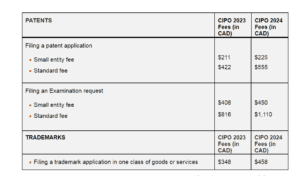
Effective January 1, 2024, a one-time 25% fee increase will be implemented, impacting most patent, industrial design, trademark and copyright fees. With respect to patent matters, this increase will not apply to businesses qualifying as a “small entity” under the Patent Rules. Thus, small entity patent applicants will only experience CIPO’s regular annual fee increase in 2024.

Below are a few examples of changes in CIPO’s fees (rounded up):

A complete listing of fee increases relating to patents, industrial designs, trademarks, copyrights, and other fees can be found on CIPO’s website here.

Expansion of the definition of “Small Entity” under the Patent Rules

Another important change is the broadening of the definition of “small entity” in the Patent Rules. This change is important because entities that meet the definition of small entity and who submit a small entity declaration are entitled to a 50% reduction of some CIPO patent-related fees.

Currently, a “small entity” is defined as a university or an entity that employs 50 or fewer employees at the time the patent application was filed or at the national phrase entry date for an international PCT application but does not include:

(a) an entity that is controlled directly or indirectly by an entity other than a university, that has more than 50 employees, or

(b) an entity that has transferred or licensed, or has an obligation other than a contingent obligation to transfer or license, any right or interest in a claimed invention to an entity other than a university that has more than 50 employees

The definition of “small entity” will be amended effective January 1, 2024, to increase the maximum number of employees from 50 employees to fewer than 100 employees. Thus, more companies will be able to qualify for the small entity category and, as a result, utilize the lower small entity fees. Please note that small entity status is determined at the time of filing (or at the national phrase entry date) and is only determined once.

This amendment does not entitle newly qualifying small entities to a partial refund of fees paid before January 1, 2024. The amendment is, however, allowing applicants who had more than 50 employees but less than 100 employees at the time of filing (or at the national phrase entry date) to start paying future fees at the small entity rate after January 1, 2024, provided all other small entity conditions were met when the patent was filed, and a small entity declaration is submitted.

Recommendations

1. As a result of these changes, individuals and businesses are encouraged to review their IP portfolios with their IP professional for possible new filings, examination requests and renewal/maintenance fees that can be done before January 1, 2024, to take advantage of the lower 2023 rates before the 25% increase takes effect.

2. Additionally, applicants should also review with their IP professional whether they will qualify as of January 1, 2024, for the expanded small entity status.

For more information, please contact:
Randy Marusyk, Co-Managing Partner
T: 613-801-1088
E: rmarusyk@mbm.com


This article is general information only and is not to be taken as legal or professional advice. This article does not create a solicitor-client relationship between you and MBM Intellectual Property Law LLP. If you would like more information about intellectual property, please feel free to reach out to MBM for a free consultation.


Industrial Designs – Why Should You Protect Your Unique Designs?

Industrial designs (“ID”) protect a product’s unique appearance such as shape, configuration, pattern and/or ornamental features. The protection can be obtained for the design of the entire finished article or just a part of it. Examples of industrial designs can be found everywhere, ranging from your cellphone’s overall shape and graphic user interface to the colour patterns of your clothes.

The exclusive right conferred by the Industrial Design Act does not extend to what the design is made of, how it is made, or how it works. These types of considerations are protectable through patents or trade secrets. However, too often, companies focus primarily on patent protection to the exclusion of other intellectual property rights. Simply put, industrial design protection should not be neglected where shape and configuration assist in a product’s marketability. ID protection can be used alone or in conjunction with other forms of intellectual property as a less expensive means to stop infringing activity.

HOW THE REGISTRATION SYSTEM WORKS IN CANADA

Canada employs a first-to-file system which means it is not necessarily who designed first that is entitled to an ID registration but rather it is a race of who files it first at the Canadian Intellectual Property Office (“CIPO”). To obtain an ID registration, it is necessary that the design be novel, which means that no identical or substantially similar design has ever been registered or disclosed. Therefore, if designer ‘1’ created a novel design before designer ‘2’ but designer ‘1’ did not file an application or publicly disclose the novel design (i.e., left the design prototype in their garage or computer) and designer ‘2’ independently created a substantially similar design and filed for the design within 12 months from designer ‘2’s’ public disclosure, then designer ‘2’ will be entitled to the industrial design registration. Notably, an applicant (i.e., designer ‘2’) is given a 12-month window (grace period) to file from its public disclosure or the public disclosure by a person who obtained knowledge of the ID directly or indirectly from the applicant (designer ‘2’).

Before filing, you should conduct a thorough search, preferably with professional assistance from an intellectual property lawyer, to ensure your design is novel and has not been previously registered or disclosed.

Applications are kept confidential until the earlier of either the registration date or 30 months after the application filing date or priority date. Therefore, the design disclosed in the application will become available to the public following the expiry of the confidentiality period. As such, if an applicant does not wish to disclose a design prior to a product launch, careful consideration should be given to the approximate time it typically takes from application to registration of an ID (12 to 18 months).

After registration, you only have to pay a one-time maintenance fee at the 5-year mark. The application process for an industrial design is much faster than that of a patent application. The exclusive right granted by the CIPO registration begins on the registration date and ends on the later of the end of 10 years after the registration date or the end of 15 years after the filing date. Therefore, an ID registration exclusivity is anywhere from 10 to 15 years.

CONVERTING AN INDUSTRIAL DESIGN INTO A “PERPETUAL” TRADEMARK RIGHT WHICH CAN BE USED TO ENFORCE COPYRIGHT

Through proactive and strategic planning, ID’s can be used as an effective tool to ultimately result in perpetual protection for a design.

Designs such as three-dimensional shapes can be registered as non-traditional trademarks under the Trademarks Act. However, in order to obtain a shape trademark registration, unlike a regular trademark, it is necessary to provide proof (evidence) of distinctiveness of the trademark at the date of filing of the shape trademark application. To overcome the hurdle of distinctiveness, a meaningful strategy is to first secure an industrial design registration, build up distinctiveness through the monopoly granted by the industrial design registration, and at some point, during the term of the ID registration, file an application for the shape trademark. Once registered, the shape trademark is valid for 10 years and can be renewed indefinitely every 10 years. In other words, a shape trademark can exist in perpetuity with use.

The Canadian Copyright Act permits the reverse engineering of an article if more than 50 articles are made. However, if the article (i.e., shape) is itself a trademark, then it is prohibited to reverse engineer the article without infringing copyright. Therefore, the ID can be used to support a distinctiveness claim for trademark rights and ultimately lead to enforcement through copyright.

INTERNATIONAL PROTECTION BY THE HAGUE SYSTEM

To avoid submitting individual applications in each country of interest, the Hague System for the International Registration of Industrial Designs provides an option to register an industrial design in multiple countries by filing a single international application (Hague application) with the International Bureau (IB) of World Intellectual Property Organization (WIPO).

The IB of WIPO verifies compliance with formal requirements only, without any examination for novelty. A Hague application that complies with the formal requirements is recorded in the International Register and published in the International Designs Bulletin, followed by a substantial examination by each country identified in your application under its domestic law.

In respect of Canada, the international registration is valid for the first 5 years from the date of the international registration and may be renewed twice, namely, at the 5-year mark and the 10-year mark.

SUMMARY

A valid ID registration provides the exclusive right to prevent others from making, selling or importing an article that embodies or is substantially similar to the registered ID.

Always try to think outside the box as part of your business strategy as it is important to identify all aspects of your IP assets. For example:

  • a unique design may be protected by an ID registration;
  • the new, inventive and useful functionality of the product may be covered by a patent;
  • the logo of the product may be registered as a trademark;
  • the advertising campaign video to promote your product may be protected by copyright.

In conclusion, you should always utilize a combination of IP assets to maximize your IP protection, depending on your budget and your new product development plan.

If you have any intellectual property questions, please feel free to reach out to MBM for a free consultation.

For more information please contact:
Scott Miller, Co-Managing Partner, Head of the Litigation Department
T: 613-801-1099
E: smiller@mbm.com

This article is general information only and is not to be taken as legal or professional advice. This article does not create a solicitor-client relationship between you and MBM Intellectual Property Law LLP. If you would like more information about intellectual property, please feel free to reach out to MBM for a free consultation.

Tips For Startups: How To Make Sure Your IP Is Working For You

Two things that startups never seem to have enough of are: time and money. It can be difficult to carve out enough of both to properly identify, manage, and protect your intellectual property (IP). Your IP, including your patents, industrial designs and trademarks, is at the center of your company’s value. As a result, protecting your IP is crucial and will give your company the boost it needs to succeed in a competitive marketplace. Knowing your IP is essential to identifying your competitive advantage, focusing your R&D efforts, and creating an innovative company culture. IP should be the main component of your business plan and your pitch to customers and investors as it is normally your main selling point.

As a startup, you already have passion for your business, and you are convinced that you will be successful. Now, in order to apply your passion to the right strategy, you should ask yourself a series of questions to help pinpoint and identify what IP you currently possess and if it is valuable:

  • What you are doing that is new? What new features have you added, or improvements have you made lately?
  • What makes your product better, or faster, or more accurate, or more efficient than your competitor’s products?
  • What features of your product do customers value the most when making purchasing decisions?
  • Is your company name or logo unique in your industry? Did you check to make sure no one else has it registered as a trademark?
  • Have you designed a new product with a distinctive name, product shape, physical design or packaging?
  • Once you choose your name and logo, have you been consistently using it on your products, packaging, marketing materials, your website and your social media? Document the date you first used it!

One way to answer these questions is to formally evaluate your IP, you could use an IP law firm to do it, which is always recommended but you could also try to figure it out yourself by doing some market and competitor research.

Ideas born from your IP evaluation can form the basis for the future direction of your R&D, which will eventually turn into more patents, industrial designs, and trademarks that you will want to protect and leverage going forward.

Now that you have defined your “secret sauce” you can use it in several ways:

  • File a patent to demonstrate that you have a technological advantage important enough that you are willing to invest in a patent to protect it.
  • Gain credibility with financial investors and VCs. Include it in your pitch and highlight it in your business plan.
  • Get your sales and marketing people to highlight the IP incorporated into your products when interacting with customers.
  • Use your IP to develop and foster a culture of innovation in your company. Celebrate inventors to encourage the generation of new ideas.
  • Leverage your IP to form strategic partnerships and alliances to scale up your business or license out your IP for royalty revenue.
  • Build and protect your brand by consistently monitoring your trademarks to make sure no competitors are using them, and cause customers to mistake a competitor’s product for yours.

Your IP is already there. However, you need to take the time to identify it, protect it, then learn how to artfully articulate it to investors and customers to get the most out of it.

For more information, please contact:

T: 613-567-0762
E: general@mbm.com

Author: David Fraser, Patent Agent


This article is general information only and is not to be taken as legal or professional advice. This article does not create a solicitor-client relationship between you and MBM Intellectual Property Law LLP. If you would like more information about intellectual property, please feel free to reach out to MBM for a free consultation.

Are you utilizing your IP to obtain financing and grow your business?

Intellectual property (IP), including patents, industrial designs and trademarks, is an under-utilized business tool for small medium enterprises (SMEs).  Regardless of company size, IP may be used to:

  • Obtain financing
  • Generate revenue through licensing opportunities
  • Protect and/or expand market share

This is highlighted in the 2019 IP Canada Report from the Canadian Intellectual Property Office in the section entitled “[t]he impact of IP on financing and growth of small and medium enterprises” (https://www.ic.gc.ca/eic/site/cipointernet-internetopic.nsf/eng/h_wr04682.html). In particular, the 2019 IP Canada Report summarized the results of ISED 2017 Survey on Financing and Growth of Small Medium Enterprises.  The following points are of particular interest:

  • While more than half of Canadian SMEs are aware of patents, very few have patents.
  • The proportion of Canadian SMEs holding at least one patent increases as size of SMEs increases.  In particular, 3% of SMEs having 20 to 99 employees hold at least one patent while 15% of SMEs having 100 to 499 employees hold at least one patent.
  • Canadian SMEs aware of IP or holding formal IP obtained more financing as compared to SMEs not aware or not using IP.
  • Canadian SMEs aware of IP or holding formal IP increased domestic and international market expansion as compared to SMEs not aware or not using IP.
  • Canadian SMEs aware of IP or holding formal IP increased growth as compared to SMEs not aware or not using IP.

It is important to start a formal conversation about some forms of IP at the outset of your business, even if you don’t have the funds to invest in it right away. A strategy should be devised to plan for it in the future and allocate some budget to properly protect your IP. An intellectual property professional can help you determine what IP is appropriate for your business and how much to budget for it. Intellectual property, especially for start-ups or an SMEs, is considered to be one of its biggest business assets and as such should be treated with extreme care. An IP professional can help you maximize business opportunities out of your intellectual property if the right strategy is in place.

For more information please contact:

Kay Palmer, Ph.D., Senior Patent Agent
T: 613-801-0452
E: kpalmer@mbm.com

This article is general information only and is not to be taken as legal or professional advice. This article does not create a solicitor-client relationship between you and MBM Intellectual Property Law LLP. If you would like more information about intellectual property, please feel free to reach out to MBM for a free consultation.


Are you trying to decide whether to register your Industrial Design in Canada?

A Canadian Industrial Design registration protects original visual features of shape, configuration, pattern or ornament, or any combination of these features, applied to a finished product. Industrial designs are commonly used to protect the outside shape and design of a wide variety of mass produced articles from light fixtures to kitchenwares. Industrial Designs do not protect functional features, they only protect a product’s appearance.

When you register your Industrial Design, you gain exclusive, legally enforceable rights in Canada for five years from the date of registration, and extendable to 10 years with payment of a maintenance fee. You may sell your rights or license others to make, use and sell your design.
In Canada there is a one year grace period to file an Industrial Design application after you make your design public anywhere in the world. It is still recommended to file an Industrial Design application as soon as possible since the design must be original and cannot closely resemble another person’s previously released design.

A Canadian Industrial Design application typically includes multiple views of the “finished article” representing the product in an assembled state. The views can be shown in photographs, but more commonly line drawings are used to ensure the design features are clearly captured. While only one view is required, please note that only features of the design included in the views provided are protected. Typically 6 views are recommended: top, bottom, front, back, left side, and right side. In some cases a perspective view is included, and identical views (e.g. identical left and right side views) may be represented by one of the two identical views.

…Outside Canada…

If you also plan to sell your products outside of Canada, then you might consider filing a Design Patent in the United States or a Community Design in the European Union. The first design application may support a priority claim in foreign countries as long as corresponding applications are filed within six months of the filing date of the first design application. For instance, a Design Patent may be filed in the United States, and within six months an Industrial Design application may be filed in Canada and claim the benefit of the earlier U.S. filing date. Using priority filings can simplify the process of filing multiple design applications in different countries.

So Should You Register An Industrial Design?

Registering an Industrial Design in Canada is an investment to help protect the appearance of your products. Obtaining an Industrial Design in Canada is much less expensive and time consuming than obtaining a patent making this an economical and effective form of industrial protection. While Industrial Designs only protect the look of a product, and not its function, in many cases the outer form of a product is part of its identity and marketability.

If you have any questions about Canadian Industrial Designs or are ready to start an Industrial Design application, please do not hesitate to contact us. We are always happy to help.

For more information, please contact:

T: 613-567-0762
E: general@mbm.com

Author: Etienne de Villiers, Of Counsel


This article is general information only and is not to be taken as legal or professional advice. This article does not create a solicitor-client relationship between you and MBM Intellectual Property Law LLP. If you would like more information about intellectual property, please feel free to reach out to MBM for a free consultation.


Upcoming Amendments to the Patent Rules, Industrial Design Regulations, and the Trademarks Regulations

The Canadian Intellectual Property Office (CIPO) has just announced that it will be conducting a series of consultations on proposed regulatory amendments to the Trademarks Regulations, Industrial Design Regulations and Patent Rules.

The amendments are being proposed to bring Canada’s intellectual property (IP) legal framework in line with international standards. In particular, Canada is in the process of joining five international IP treaties: the Madrid Protocol, the Singapore Treaty, the Nice Agreement, the Hague Agreement, and the Patent Law Treaty.

Amendments to the Trademarks Act, the Industrial Design Act and Patent Act were previously amended to comply with the requirements of these treaties. In order to complete the changes to Canada’s IP legal framework, the accompanying Regulations and Rules must also be amended.

CIPO will be consulting with the IP legal community starting on June 19, 2017 for the Trademarks Regulations and the Industrial Design Regulations. Consultations regarding the Patent Rules are scheduled to start in early August 2017. The proposed amendments will be disclosed during this consultation period, and there will be an opportunity to ask questions and submit questions or comments.

Amending the IP Rules and Regulations is the final step in a major makeover of Canada’s IP legal framework that will bring us closer to the developing international standards. From an IP owner’s point of view, these changes will make it more efficient to obtain patent protection in Canada based on foreign originating applications, and similarly will make it more efficient for Canadians to obtain foreign patent protection based on Canadian originating applications.

For more information, please contact:

T: 613-567-0762
E: general@mbm.com

Author: Etienne de Villiers, Of Counsel

This article is general information only and is not to be taken as legal or professional advice. This article does not create a solicitor-client relationship between you and MBM Intellectual Property Law LLP. If you would like more information about intellectual property, please feel free to reach out to MBM for a free consultation.

In for a penny, in for a pound…

I hear it all the time … “I can’t afford to protect my intellectual property.” Let me tell you that the reverse is true for a startup … you can’t afford NOT to protect your intellectual property! If you’ve decided to take the leap and embark on a start-up adventure, then you will want to do everything in your power to succeed.

Early stage companies are typically built on a great idea and a lot of hope. These companies have not yet had the opportunity to acquire tangible assets or to build significant sales revenue (if any!). Consequently, the value in these companies is often in their ideas and their ability to create products/services from those ideas. Potential investors and partners won’t take a second look at a company if those ideas are not protected, or protectable. The assumption is that all new companies have a great idea, however, investors and partners alike need to know that they will have a defensible competitive advantage over other companies before they join in developing and growing such early stage endeavors. It’s all about mitigating risk.

Market exclusivity typically requires strong intellectual property protection. But what does that mean for a start-up, with limited resources and a nascent technology? I have identified below four general areas of focus for valuable IP protection that are important to early stage companies.

Avoid costly complications:

  • Know the competitors’ IP so you know where or what the company has freedom to practice without risk of infringement;
  • Ensure that employees and contractors assign their IP rights to the company upfront;
  • Scrutinize all third party agreements, including so-called “standard” agreements (e.g., confidentiality agreements), to ensure that they do not restrict or damage the company’s IP rights
  • Teach employees about IP

Be proactive:

  • Create a working environment that fosters innovation
  • Identify inventions early and keep quiet until they are protected
  • Reassess IP regularly to ensure it remains consistent with the company’s commercial and business plans

Use appropriate IP protection:

  • Don’t rely solely on patents: consider trade secret protection and remember the value of brand protection through trademarks
  • With respect to patents, invest in quality applications rather than a lot of applications
  • Invest in IP protection in as many jurisdictions of commercial relevance as possible, while also considering strength of protection available in each jurisdiction

Look for opportunities to fund IP:

  • Government grants for startups that support IP expenditures
  • Monetize company IP (e.g., in non-commercial fields of use, or jurisdictions; or IP that has become irrelevant)

Finally, talk to your intellectual property advisor! For early stage companies in particular, it can be beneficial to select an advisor who can act as a virtual in-house professional, with a good understanding of the company’s business goals. This provides both the company and the IP advisor the opportunity to proactively and strategically grow the value of the company’s IP portfolio.

Ultimately, because of their limited resources, early stage companies may need to be even more tactical than large corporations in how they handle their IP. However, investing the time and money to ensure that the company’s IP is properly protected will pay dividends in the long run!

This article is general information only and is not to be taken as legal or professional advice. This article does not create a solicitor-client relationship between you and MBM Intellectual Property Law LLP. If you would like more information about intellectual property, please feel free to reach out to MBM for a free consultation.

Top Top